Spanish mackerel size limit: 12 inches, bag 15
On this page
Open year-round
- Size12" fork length
- Bag15 per harvester
- SeasonOpen year-round
12 inches fork length, 15 per harvester, open year-round in Gulf and Atlantic state waters. Measure fork length from the closed mouth to the fork of the tail. How to measure.
Spanish mackerel size and bag: 12 inches fork length and 15 per harvester in Gulf and Atlantic state waters, open year-round. FWC prints one rule for both coasts. The same size and bag apply on a pier. A pier license does not waive them. Legal gear includes hook and line, cast net, spear, and beach or haul seine.
What you need in one box
- Rules in flux
- SAFMC port meetings under way that may affect future management.
- Size
- 12" fork length
- Bag
- 15 per harvester
- Season
- Open year-round
- Waters
- Gulf and Atlantic state waters, one rule
- On a pier
- Same 12" fork length and 15 per harvester
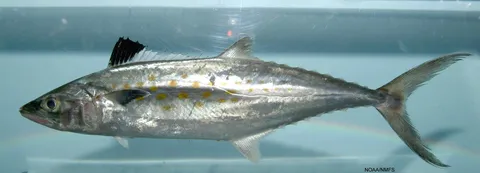

Spanish mackerel limits
| Waters | Size | Bag | Season |
|---|---|---|---|
| Gulf and Atlantic state waters | 12" fork length | 15 per harvester | Open year-round |
Fork length, not the tail tips
The minimum is 12 inches fork length. Measuring to the tips of the tail is the wrong end of the fish.
FWC fish measurement measures fork length from the tip of the jaw or the tip of the snout, mouth closed, to the center of the fork in the tail. Total length keeps going to the farthest tip of the pinched tail. Spanish mackerel are on the fork-length list, with king mackerel, cobia, permit, and pompano. A fish that reaches 12 inches only because the tape includes the tail tips past the fork can be short of the fork-length minimum.
The bag is 15 per harvester, open year-round, in Gulf and Atlantic state waters. FWC prints one block and does not print a separate coast number or a federal bag on that page. The same 12 inches and the same 15 apply on a pier, a jetty, or a bridge. A pier license covers the fishing license. It does not waive the size or the bag. Legal gear on the recreational page is beach or haul seine, cast net, hook and line, and spear. Rule 68B-23.006 says the same list, and it says spearing. Gear that is not on that list is prohibited. Lay a flexible tape flat and take a straight line. Do not follow the curve of the fish. King mackerel and Spanish mackerel are both on the fork-length list.
Spanish mackerel or a juvenile king: three checks
A short king can wear yellow spots. FWC's king profile says juveniles may have yellowish spots, similar to Spanish mackerel, and that adult kings have no spots. Spots alone do not make the fish a Spanish mackerel. Run the three marks the profiles actually print.
- Lateral line. Spanish mackerel: it slopes gently from behind the gill cover to the tail. King mackerel: it drops sharply below the second dorsal fin.
- Front of the first dorsal fin. Spanish mackerel: a bluish-black blotch. King mackerel: no dark blotch there. Cero, which FWC lists beside Spanish, also has that blotch, plus a yellowish stripe on the sides.
- The limit you are about to use. Spanish mackerel: 12 inches fork length, 15 per harvester. king mackerel: 24 inches fork length, 3 per harvester in Gulf state waters and Monroe County, 2 per harvester in other Atlantic state waters. A spotted juvenile king that would pass a Spanish size check can still be short of 24 inches.
On a pier, work the end
FWC's Spanish profile puts the fish inshore, nearshore, and offshore, often over grass beds and reefs, and gone from north Florida water in winter. Schools move north in spring and head south when the water drops below 70 degrees F. They spawn offshore from spring through summer. The profile says diving birds on bait often mark a school. Light spinning or bait-casting tackle with 10 to 15 pound line is what FWC calls adequate, with small shiny spoons, dusters, or jigs.
The beach and pass piers linked on this page are that nearshore water. The size and the bag do not change because you are standing on concrete.
Fluorocarbon tippet and wire
FWC's Spanish profile says a 30 to 60 pound monofilament leader is required because the teeth are sharp, on 10 to 15 pound line. The king profile says kings take wire or mono. The Spanish page does not say wire is illegal, and it does not mention fluorocarbon by name. Use the leader the profile names, and check it. A nicked leader is how a toothy fish ends the fight.
Landed in whole condition
The recreational Spanish mackerel page does not print a whole-condition sentence. Rule 68B-23.003 does. A person may not harvest or possess in or on Florida Waters a Spanish mackerel less than 12 inches in fork length. A person harvesting Spanish mackerel shall land each Spanish mackerel in whole condition. You may not possess, in or on Florida Waters, on any public or private fishing pier, on a bridge or catwalk attached to a bridge from which fishing is allowed, or on any jetty, a Spanish mackerel that has been beheaded, sliced, divided, filleted, ground, skinned, scaled, or deboned. The rule says this provision will not be construed to prohibit the evisceration (gutting) of a Spanish mackerel or removal of gills from a Spanish mackerel.
Red drum is a different sentence. That page prints "Must remain in whole condition until landed ashore." It is quoted on redfish limits by region. It is not the Spanish rule.
Do not pass Spanish mackerel to another boat
Rule 68B-23.004 is titled Bag and Vessel Limits. The recreational line is 15 Spanish mackerel per day for a recreational harvester. Except for the for-hire trip exception, that person may not possess more than 15 in or on Florida Waters, or on a dock, pier, bridge, beach, or other fishing site next to those waters. The rule says Spanish mackerel recreationally harvested may not be transfered between vessels within Florida Waters. That is the rule's spelling.
Once a charter is docked, the captain or crew may each temporarily hold more than the possession limit to transport, clean, or store a customer's fish. The fish have to be segregated by customer, and the customer has to give written authorization that stays on the bag or container until the fish go back to that customer. That is not a second bag for the crew. The vessel limits later in the same rule are commercial pound limits. They are not a recreational boat limit. The recreational page does not print one. For-hire trips that run long enough for a second daily bag are on extended for-hire bag limits. The rule's hours are more than 24 hours in the East Coast Region and more than 30 hours in the West Coast Region.
East Coast Region and the recreational season
Rule 68B-23.005 says the season for recreational harvest of Spanish mackerel is open throughout the year. That matches the recreational page. The same rule has commercial seasons. Those are not the recreational season, and the pound limits are not copied here.
Rule 68B-23.002 defines the East Coast Region as Florida waters along the east coast north of the Miami-Dade/Monroe county line at Card Sound. The West Coast Region is all other Florida waters. The recreational page still prints one size and one bag for Gulf and Atlantic state waters. This site is unofficial. Confirm the MyFWC Spanish mackerel page before you fish.
Rules in flux. SAFMC port meetings under way that may affect future management.
How do you pick out a Spanish mackerel?
- Back is bluish-green, fading to silvery sides and belly, with irregular golden-yellow spots.
- Bluish-black blotch on the front of the first dorsal fin. The king profile says the front of a king's first dorsal fin lacks that blotch.
- The lateral line slopes gently from behind the gill cover to the tail. A king mackerel's lateral line drops sharply below the second dorsal fin.
- The Spanish profile says cero has a yellowish stripe on the sides. Size on the profile: up to 36 inches. State record: 12 lb, caught near Ft. Pierce.
Kings and wahoo
- King mackerel. Kings lack adult spots, the front of the first dorsal lacks a dark blotch, and the lateral line drops sharply. The king minimum is 24 inches fork length, with a bag of 3 or 2.
- King vs. Spanish mackerel. Profile marks and the two limits on one page, so a spotted juvenile king is not measured as a Spanish mackerel.
- Wahoo. Wahoo are longer and slimmer, with wavy dark bars and a long, low first dorsal fin.
Where do Spanish mackerel school in Florida?
Prevalent throughout Florida waters: inshore, nearshore, and offshore, frequently over grass beds and reefs. Absent from north Florida waters in winter. Schools migrate northward in spring and return south when the water temperature drops below 70 degrees F. They spawn offshore from spring through summer and feed on small fishes and invertebrates. Diving birds on schools of baitfish often mark them. Light spinning or bait-casting tackle with 10 to 15 pound monofilament line is adequate. A 30 to 60 pound monofilament leader is required because the teeth are razor sharp. The profile names small shiny spoons, dusters, or jigs.
Piers and bridges on this site
- Skyway Fishing Pier State Park, St. Petersburg / Tampa Bay
- Fort De Soto Park Gulf & Bay Piers, Tierra Verde (Pinellas County)
- Venice Fishing Pier, Venice
- Naples Pier, Naples (Collier County)
- Jacksonville Beach Fishing Pier, Jacksonville Beach (Duval County)
- St. Johns County Ocean Pier, St. Augustine Beach (St. Johns County)
- Navarre Beach Pier, Navarre Beach (Santa Rosa County)
- Russell-Fields City Pier, Panama City Beach (Bay County)
Regions on this site
- Panhandle & Emerald Coast fishing rules
- Tampa Bay fishing rules
- Sarasota & Southwest fishing rules
- Florida Keys fishing rules
- Jacksonville & Northeast fishing rules
- Southeast & Treasure Coast fishing rules
- King vs. Spanish mackerel
- King mackerel
- Bag limits on a pier
- How fork length is measured
- Extended for-hire bag limits
- Florida fishing piers
- Billfish, tuna and swordfish
- Saltwater fishing license
- 2026 closed seasons calendar
- Open now and closing soon
- What to catch by month
Questions anglers ask
What is the Spanish mackerel size and bag limit in Florida?
12 inches fork length and 15 per harvester in Gulf and Atlantic state waters, open year-round. FWC prints one rule for both coasts. Measure fork length, from the closed mouth to the fork of the tail, not total length.
Do Spanish mackerel size and bag limits apply on a pier?
Yes. The 12 inch fork-length minimum and the bag of 15 per harvester still apply on a pier, jetty, or bridge. A Saltwater Fishing Pier License covers the license. It does not waive the size or the bag.
What is the Spanish mackerel size limit?
12 inches fork length in Gulf and Atlantic state waters.
What is the Spanish mackerel bag limit?
15 per harvester, in Gulf and Atlantic state waters, including from a pier.
Is Spanish mackerel open year-round?
Yes. FWC lists the Gulf and Atlantic state-waters season as open year-round. The page does not print a separate federal bag.
How do you tell Spanish mackerel from king mackerel?
Spanish mackerel have golden-yellow spots, a blotch on the front of the first dorsal fin, and a gently sloping lateral line. King mackerel do not. Juvenile kings may still show yellowish spots. The king minimum is 24 inches fork length.
Can you fillet Spanish mackerel on the boat?
No. Rule 68B-23.003 says each Spanish mackerel shall be landed in whole condition. You may not possess, in or on Florida Waters or on a pier, a bridge or catwalk, or a jetty, a Spanish mackerel that has been beheaded, sliced, divided, filleted, ground, skinned, scaled, or deboned. The rule says that does not prohibit evisceration (gutting) or removal of the gills. The recreational page does not print this sentence. The rule does.
How do you read the Spanish mackerel limit table?
One row covers Gulf and Atlantic state waters together. Size is 12 inches fork length, bag is 15 per harvester, and the season cell is open year-round. There is no separate Atlantic row. State waters are from shore to 3 miles in the Atlantic and from shore to 9 miles in the Gulf.
Do Gulf and Atlantic Spanish mackerel use different rows?
No. The single row applies the 12 inch fork length and the bag of 15 per harvester to Gulf and Atlantic state waters, and the season cell is open year-round.