Redfish limits by region: 18–27 inch slot
On this page
Redfish, where you can keep one: the slot is 18 to 27 inches total length and the bag is 1 red drum per person per day in every region that allows harvest. Vessel limits are 4 in the Panhandle, Big Bend and Northeast and 2 elsewhere. The Indian River Lagoon is catch-and-release only.
The numbers, briefly
- Status
- Open year-round; Indian River Lagoon catch-and-release only
- Size
- 18–27" total length
- Bag limit
- 1 per person per day; vessel limit 2 or 4 by region
- Permits
- Saltwater fishing license (unless exempt)
This site is unofficial. It is not FWC. Match your water to a region on the MyFWC red drum page before you keep a fish.
- Panhandle
- Big Bend
- Tampa Bay
- Sarasota Bay
- Charlotte Harbor
- Southwest
- Southeast
- Indian River Lagoon
- Northeast
- Inland – see FWC rule text
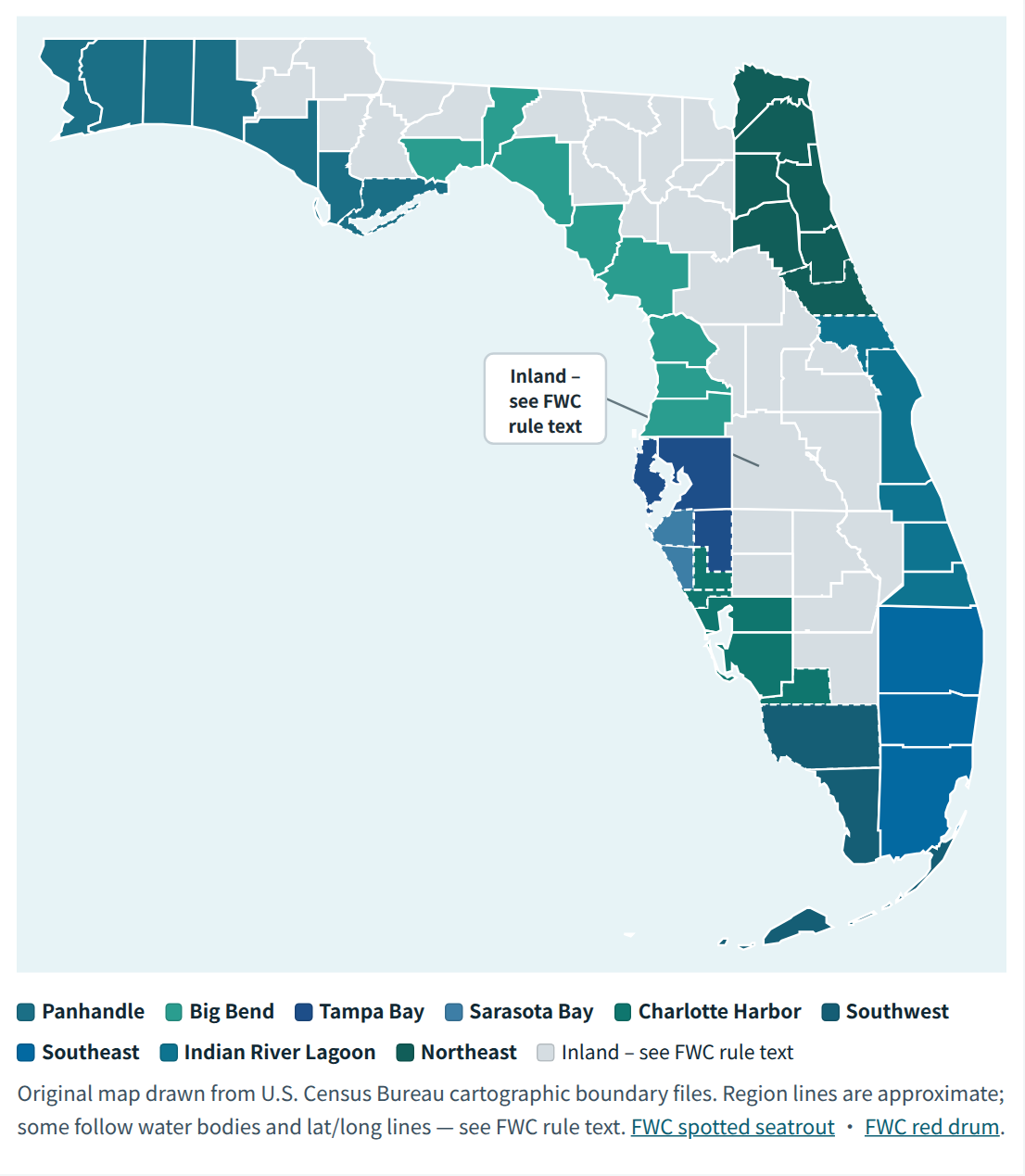

Red drum regulations by region
| Region | Season | Slot | Bag | Vessel limit |
|---|---|---|---|---|
| Panhandle | Year-round | 18–27" | 1 | 4 |
| Big Bend | Year-round | 18–27" | 1 | 4 |
| Tampa Bay | Year-round | 18–27" | 1 | 2 |
| Sarasota Bay | Year-round | 18–27" | 1 | 2 |
| Charlotte Harbor | Year-round | 18–27" | 1 | 2 |
| Southwest | Year-round | 18–27" | 1 | 2 |
| Southeast | Year-round | 18–27" | 1 | 2 |
| Indian River Lagoon | Catch-and-release only | n/a | 0 | 0 |
| Northeast | Year-round | 18–27" | 1 | 4 |
Species detail is on red drum (redfish). Black drum are a different slot and a different gear list: black drum, or the side-by-side on red drum vs. black drum. Snook dates are on the snook season page. Permit size and bag are on permit. This page states no closed season. Dated closures for other species are on the Florida fishing closed seasons 2026 calendar.
The nine redfish regions, on landmarks you can see
Where harvest is open, the slot is not less than 18 inches and not more than 27 inches total length, and the bag is 1 red drum per person per day. The vessel number changes with the region. The Indian River Lagoon is catch-and-release only.
The sentences below are the boundary paragraphs on FWC's red drum page. They are not the snook boundary paragraphs, which differ on Palma Sola Bay and a few rivers. If a landmark is not in the red drum paragraph, it is not in this table.
| Region | Vessel | Boundary FWC prints |
|---|---|---|
| Panhandle | 4 | Western boundary at the Florida-Alabama border, east near Alligator Point. Does not include all waters of the Ochlockonee Bay, the Ochlockonee River and its tributaries. |
| Big Bend | 4 | Western boundary near Alligator Point. Includes all waters of the Ochlockonee Bay, the Ochlockonee River and its tributaries. Extends east and south to Fred Howard Park, near the border of Pasco and Pinellas counties. Includes all waters of the Anclote River and its tributaries. |
| Tampa Bay | 2 | Northern boundary at Fred Howard Park, near the border of Pasco and Pinellas counties, south to State Road 64 in Manatee County. Includes all waters of the Braden River and Manatee River, and its tributaries. Does not include the Anclote River and its tributaries. |
| Sarasota Bay | 2 | From State Road 64 in Manatee County south near the Venice Municipal Airport. Includes Palma Sola Bay. |
| Charlotte Harbor | 2 | From near the Venice Municipal Airport south to near Vanderbilt Beach Road in Collier County. |
| Southwest | 2 | From near Vanderbilt Beach Road in Collier County around the Florida Keys to the Monroe/Miami-Dade County line. |
| Southeast | 2 | From the Martin-Palm Beach county border south to the Miami-Dade/Monroe County line. Includes the Loxahatchee River and its tributaries. Special regulations apply in Biscayne National Park. |
| Indian River Lagoon | 0 | From Lytle Avenue/South Causeway in New Smyrna Beach south to the Martin-Palm Beach County line. Does not include the Loxahatchee River or its tributaries. Catch-and-release only. |
| Northeast | 4 | From the Florida-Georgia border south to Lytle Avenue/South Causeway in New Smyrna Beach. |
Indian River Lagoon: catch-and-release only
FWC prints two words for the Indian River Lagoon region: Catch-and-release only. There is no slot to meet and no fish to put in the boat. The northern boundary is Lytle Avenue/South Causeway in New Smyrna Beach. The southern boundary is the Martin-Palm Beach County line. The Loxahatchee River and its tributaries are not in this region. They are in the Southeast region, which has the 18 to 27 inch slot, 1 fish per person, and a 2-fish vessel limit.
The red drum management note on the same page says stocks are exceeding a 40 percent escapement goal in most parts of Florida, and that in 2022 FWC moved to smaller regions scored on six metrics: escapement, relative abundance, habitat, harmful algal blooms, fishing effort, and stakeholder feedback. Habitat is one of those six words. The page does not say the lagoon is closed because of a seagrass loss, and this site does not add that cause. FWC links a 2025 Indian River Lagoon Redfish Annual Review. This page does not restate that PDF.
Vessel limits change with the region
Panhandle, Big Bend, and Northeast print a 4-fish vessel limit. Tampa Bay, Sarasota Bay, Charlotte Harbor, Southwest, and Southeast print 2. The Indian River Lagoon prints no harvest. The bag in every open region is still 1 fish per person per day. A 4-fish vessel limit is not a 4-fish personal bag.
Each row is the limit for that region's water. The recreational page does not print a sentence that lets a boat keep the Big Bend 4-fish vessel limit after it enters Tampa Bay, and it does not print a transit exception. Rule 68B-22.005 is titled Regional Recreational Bag, Vessel, and Possession Limits; Bag Limit for Captain and Crew on For-hire Trips; Sale Prohibited. The Word file was not opened, so the possession wording beyond the sentences FWC prints on the recreational page is not copied here. Captain and crew may not keep a bag on a for-hire trip. Commercial harvest is prohibited.
The transport limit, the dock, and the parking lot
FWC prints three possession lines under Other Regulations. Bag limits apply in areas adjacent to fishing sites, such as docks and parking lots. A 4 fish per person transport limit applies when you are traveling in a vehicle on land away from a fishing site. The fish must remain in whole condition until landed ashore.
The transport number is 4 per person, including where the vessel limit on the water was 2. It is not a second bag you add to the fish already on the boat. The dock and the parking lot next to the ramp still use the bag for the water you were fishing. How to measure is the pinched-tail method for the 18 to 27 inch slot.
Pinched-tail total length on a redfish
The slot is total length: not less than 18 inches and not more than 27 inches, mouth closed, fish on its side, tail pinched so you reach the farthest tip. A tape run over the curve of the body reads long. Fish over 27 inches go back, and so do fish under 18. The Indian River Lagoon does not have a slot to measure into. The same pinched-tail steps are on flounder, which uses total length for a 14-inch minimum.
Escapement, and the old March–May closure
The region boxes on the MyFWC page say open year-round wherever harvest is allowed, and catch-and-release only in the Indian River Lagoon. The management note on that same page also describes 1989. In the late 1980s red drum were overfished. In 1989 FWC put in the 18–27 inch slot, a bag of one fish per person, and a closed season from March through May. That March–May closure is the 1989 history in the note. It is not the season in the region boxes now.
FWC defines escapement as the proportion of fish that survive through age four, relative to the fish that would have survived if there was no fishery. The note says stocks are currently exceeding the management goal of 40% escapement in most parts of Florida. In 2022 FWC moved to smaller regions scored on six metrics: escapement, relative abundance, habitat, harmful algal blooms, fishing effort, and stakeholder feedback. Each year those regions get an annual review. This page does not restate the PDFs.
- 2025 Panhandle Redfish Annual Review
- 2025 Big Bend Redfish Annual Review
- 2025 Tampa Bay Redfish Annual Review
- 2025 Sarasota Bay Redfish Annual Review
- 2025 Charlotte Harbor Redfish Annual Review
- 2025 Southwest Redfish Annual Review
- 2025 Southeast Redfish Annual Review
- 2025 Indian River Lagoon Redfish Annual Review
- 2025 Northeast Redfish Annual Review
Slot wording and the gear line
Charlotte Harbor is the only open region whose slot line reads "Not less than 18" and no more than 27" total length." The other open regions omit that "and." Southwest's bag line says "2 fish per vessel limit." Tampa Bay says "2 fish vessel limit." The cap on both is 2. The Southeast accordion is where FWC prints the Biscayne National Park note for red drum. Inside the park, redfish join spotted seatrout and black drum in the 10-fish aggregate. The species bag still applies. See Biscayne National Park.
Legal gear is hook and line and cast nets. FWC's illegal-gear line: spearing (includes spearfishing, gigging and bowfishing, and snatch hooking) and/or use of multiple hooks in conjunction with live or dead natural bait. A spear or gig is on the black drum legal-gear list. It is not on this one.
Tournament culling permit
FWC links a redfish tournament culling permit from the red drum page. It is for catch-and-release tournaments only. To be eligible, a tournament needs 50 or more participants, written rules, an entry fee, and prizes. Each 2-person team may possess no more than 2 live redfish in the boat's livewell or recirculating tank at one time. The livewell has to be recirculating or aerated and at least 2.4 cubic feet or 18 gallons. A dead redfish possessed by that team may not be discarded. FWC says a dead redfish is harvested and counts as the daily bag limit for the team.
The permit can also require an aerated recovery tank and name the release spot. The tournament files a post-event report: fish weighed in, fish weighed in dead, and fish that died after the weigh-in and before release. The best-practice page is voluntary. It repeats one permit condition: only one redfish in a catch bag at a time. It recommends a 25-gallon livewell. The requirement it states is 18 gallons. The permit page does not say the 18–27 inch slot is waived. Apply with the form on that page, or call 850-487-0554. The email on the page is obfuscated, so it is not copied here.
These notes were read from the MyFWC pages on October 31, 2026. The sitewide Last verified stamp was not moved, and the slot and bag cells above were not rewritten. They already matched the region boxes.
Before you keep a fish
- Total length only, and it has to fall between 18" and 27".
- The boat cap is either 2 or 4. Know which region you're in.
- The Indian River Lagoon is release only.
- Away from the fishing site, in a vehicle, the transport limit is 4 fish per person.
- Docks and parking lots next to a fishing site still count toward the bag.
- Spearing, gigging, bowfishing and snatch hooking are out. So is a multiple hook with natural bait.
- Land the fish whole. On a for-hire trip, captain and crew don't get a bag.
Buying the permit
- Get a saltwater license at GoOutdoorsFlorida.com or a license agent if you aren't exempt.
- Match your spot to a region on the FWC red drum page.
- Have the license with you on the water.
Straight answers
What is the redfish bag limit in Florida?
One red drum per person per day wherever harvest is allowed. The boat can hold 4 in the Panhandle, Big Bend and Northeast, and 2 in Tampa Bay, Sarasota Bay, Charlotte Harbor, Southwest and Southeast. The Indian River Lagoon is catch-and-release only.
What is the redfish slot limit in Florida?
Total length, not less than 18 inches and not more than 27 inches.
Can I keep redfish in the Indian River Lagoon?
No. From Lytle Avenue/South Causeway in New Smyrna Beach to the Martin–Palm Beach county line, the Indian River Lagoon Region is catch-and-release only.
Is the Northeast redfish limit 2 per person?
No. Northeast anglers may keep 1 fish per person per day, and the vessel limit there is 4.
Is there a closed season for redfish?
No closed season. Where you can keep one, the fishery is open year-round.
What is the redfish transport limit on land?
FWC prints a 4 fish per person transport limit when you are traveling in a vehicle on land away from a fishing site. Bag limits also apply on docks and parking lots next to a fishing site. The fish must remain in whole condition until landed ashore.