Red drum (redfish) size, bag and season in Florida
On this page
Varies by region
- SlotNot less than 18" and no more than 27" total length
- Bag1 per person per day
Red drum, where harvest is open: the slot is not less than 18 inches and no more than 27 inches total length, with 1 per person per day. The vessel limit is 4 in the Panhandle, Big Bend and Northeast and 2 elsewhere. The Indian River Lagoon is catch-and-release only. Those open regions stay open year-round.
What you need in one box
- Slot
- Not less than 18" and no more than 27" total length
- Bag
- 1 per person per day
- Vessel
- 4 in Panhandle, Big Bend and Northeast; 2 in other harvest regions
- Indian River Lagoon
- Catch-and-release only
- Gear
- Legal: hook and line, cast nets. Illegal: spearing (spearfishing, gigging and bowfishing, and snatch hooking), and multiple hooks with live or dead natural bait
- Panhandle
- Big Bend
- Tampa Bay
- Sarasota Bay
- Charlotte Harbor
- Southwest
- Southeast
- Indian River Lagoon
- Northeast
- Inland – see FWC rule text

Red drum (redfish) limits
| Waters | Size | Bag | Season |
|---|---|---|---|
| Panhandle | Not less than 18" no more than 27" total length | 1 per person per day; 4 fish vessel limit | Open year-round |
| Big Bend | Not less than 18" no more than 27" total length | 1 per person per day; 4 fish vessel limit | Open year-round |
| Tampa Bay | Not less than 18" no more than 27" total length | 1 per person; 2 fish vessel limit | Open year-round |
| Sarasota Bay | Not less than 18" no more than 27" total length | 1 per person; 2 fish vessel limit | Open year-round |
| Charlotte Harbor | Not less than 18" and no more than 27" total length | 1 per person, 2 fish vessel limit | Open year-round |
| Southwest | Not less than 18" no more than 27" total length | 1 per person per day; 2 fish per vessel limit | Open year-round |
| Southeast | Not less than 18" no more than 27" total length | 1 per person per day; 2 fish vessel limit | Open year-round |
| Northeast | Not less than 18" no more than 27" total length | 1 per person per day; 4 fish per vessel limit | Open year-round |
| Indian River Lagoon | Catch-and-release only | Catch-and-release only | Catch-and-release only |
How do you recognize a redfish?
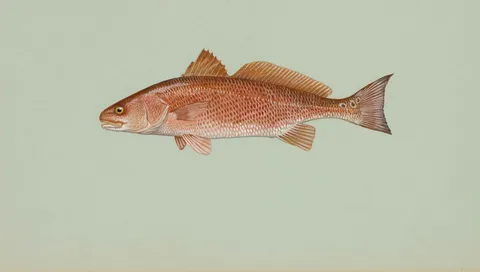
- Copper-bronze body fading to a lighter belly, with large scales.
- One or more dark, ocellated spots at the base of the tail. FWC says a fish is occasionally without a spot.
- No barbels on the lower jaw. Powerful pharyngeal teeth crush oysters and other shellfish.
- FWC lists size up to 61 inches. The state record is 52 lb 5 oz, caught near Cocoa in 1996.
Easy to mix up
- Black drum. FWC's profile: black drum have chin barbels and lack the tail spot. Red drum lack barbels. Spear or gig is legal gear for black drum and sits inside the red drum spearing prohibition.
- Red drum vs. black drum. Ocellated tail spot, chin barbels, the two slots, and which gear each page allows.
Where do red drum show up in Florida?
Red drum stick to the coast. FWC's profile calls them Florida's most widespread estuarine fish. Juveniles stay inshore until they're roughly 30 inches (about 4 years), then they join the nearshore fish. In winter, FWC puts them in seagrass, over muddy or sand bottoms, or near oyster bars and spring-fed creeks. The spawn runs from about August through December in passes, inlets and lagoon estuaries. The profile calls them prodigious spawners that produce tens of millions of eggs, and says they drum by rubbing special muscles against the air bladder. They eat fish and invertebrates. A live shrimp under a popping cork works. The profile also names crabs, mullet, pinfish and killifish (mud minnows), plus soft-bodied jigs, spoons and top-water plugs. The tournament FAQ describes the adult jaw as sub-terminal: the upper jaw extends beyond the lower jaw, the mouth of a bottom feeder. A tailing fish is usually on crustaceans.
Pier pages that match the habitat
- Skyway Fishing Pier State Park, St. Petersburg / Tampa Bay
- Fort De Soto Park Gulf & Bay Piers, Tierra Verde (Pinellas County)
- Venice Fishing Pier, Venice
- Naples Pier, Naples (Collier County)
- Jacksonville Beach Fishing Pier, Jacksonville Beach (Duval County)
- St. Johns County Ocean Pier, St. Augustine Beach (St. Johns County)
- Navarre Beach Pier, Navarre Beach (Santa Rosa County)
- Russell-Fields City Pier, Panama City Beach (Bay County)
- Long Key Viaduct Fishing Bridge, US-1, MM 63–65.5 (Monroe County)
- Ohio–Bahia Honda Channel Fishing Bridge, Lower Keys, US-1 (Monroe County)
Coasts and regions
- Panhandle & Emerald Coast fishing rules
- Tampa Bay fishing rules
- Sarasota & Southwest fishing rules
- Florida Keys fishing rules
- Jacksonville & Northeast fishing rules
- Southeast & Treasure Coast fishing rules
- Redfish limits by region
- Black drum
- Red drum vs. black drum
- Biscayne National Park rules
- How to measure fish
- Saltwater fishing license
- Shoreline license and kayaks
- Unregulated species default bag
- 2026 closed seasons calendar
- Open now and closing soon
- What to catch by month
Questions anglers ask
What is the Florida redfish size limit?
Not less than 18 inches and no more than 27 inches total length, in every region where harvest is open.
What is the redfish bag limit?
1 fish per person per day. The vessel limit is 4 fish in the Panhandle, Big Bend and Northeast regions and 2 fish in Tampa Bay, Sarasota Bay, Charlotte Harbor, Southwest and Southeast.
Can you keep redfish in the Indian River Lagoon?
No. FWC lists the Indian River Lagoon region as catch-and-release only.
What gear is legal for redfish?
Hook and line and cast nets. FWC's illegal-gear line prohibits spearing (spearfishing, gigging and bowfishing, and snatch hooking) and/or multiple hooks used with live or dead natural bait.
How do you tell a redfish from a black drum?
Red drum lack chin barbels and usually have one or more ocellated spots at the base of the tail. FWC says a fish is occasionally without a spot. Black drum have chin barbels and no tail spot.
Can a redfish tournament hold fish in a livewell?
Only a catch-and-release tournament with an FWC tournament exemption permit, and only on the permit conditions. The tournament needs 50 or more participants, written rules, an entry fee, and prizes. Each 2-person team may possess no more than 2 live redfish, in a recirculating or aerated livewell of at least 2.4 cubic feet or 18 gallons. A dead redfish may not be discarded. FWC says that dead fish is harvested and counts as the daily bag limit for the team. The permit page does not waive the 18 to 27 inch slot. Best-practice notes are voluntary, except where they repeat a permit condition such as one redfish in a catch bag at a time.
How do you read the redfish limit table?
On every harvest row the size cell is not less than 18 inches and no more than 27 inches total length, and the bag is 1 per person. The vessel figure is in that same bag cell: 4 in the Panhandle, Big Bend and Northeast, and 2 in Tampa Bay, Sarasota Bay, Charlotte Harbor, Southwest and Southeast. The Indian River Lagoon row is catch-and-release only in the size, bag and season cells, so the slot does not apply there. Harvest rows are open year-round. State waters are from shore to 3 miles in the Atlantic and from shore to 9 miles in the Gulf.
Where is the redfish vessel limit in the table?
In the bag column, not in its own column. Panhandle, Big Bend and Northeast say a 4 fish vessel limit. Tampa Bay, Sarasota Bay, Charlotte Harbor, Southwest and Southeast say 2. The Indian River Lagoon row has no vessel bag. It is catch-and-release only.