Spotted seatrout limits by Florida region
On this page
Varies by region
- SlotNot less than 15" or more than 19" total length
- Bag3 per day in most regions; Big Bend 5; Indian River Lagoon 2
Spotted seatrout slot: 15 to 19 inches total length. The bag is 3 per person in most regions, 5 in the Big Bend and 2 in the Indian River Lagoon. The Lagoon closes November 1 through December 31. The Panhandle closes in February. Northeast and Lagoon anglers may not keep a fish over 19 inches.
The numbers, briefly
- Rules in flux
- Indian River Lagoon region closes Nov 1 (per rules text).
- Slot
- Not less than 15" or more than 19" total length
- Bag
- 3 per day in most regions; Big Bend 5; Indian River Lagoon 2
- Over 19"
- One per vessel, or per person from shore, except Northeast and Indian River Lagoon, where none are allowed
- Indian River Lagoon
- Closed November 1 – December 31
- Panhandle
- Closed in February; open March 1 – Jan. 31
- Panhandle
- Big Bend
- Tampa Bay
- Sarasota Bay
- Charlotte Harbor
- Southwest
- Southeast
- Indian River Lagoon
- Northeast
- Inland – see FWC rule text

Spotted seatrout limits
| Waters | Size | Bag | Season |
|---|---|---|---|
| Panhandle | Not less than 15" or more than 19" total length | Three fish per person per day. One fish over 19" per vessel, or per person from shore, included in the bag | Closed in February. Open March 1 – Jan. 31 |
| Big Bend | Not less than 15" or more than 19" total length | Five fish per person per day. One fish over 19" per vessel, or per person from shore, included in the bag | Open year-round |
| Tampa Bay | Not less than 15" or more than 19" total length | Three fish per person per day. One fish over 19" per vessel, or per person from shore, included in the bag | Open year-round |
| Sarasota Bay | Not less than 15" or more than 19" total length | Three fish per person per day. One fish over 19" per vessel, or per person from shore, included in the bag | Open year-round |
| Charlotte Harbor | Not less than 15" or more than 19" total length | Three fish per person per day. One fish over 19" per vessel, or per person from shore, included in the bag | Open year-round |
| Southwest | Not less than 15" or more than 19" total length | Three fish per person per day. One fish over 19" per vessel, or per person from shore, included in the bag | Open year-round |
| Southeast | Not less than 15" or more than 19" total length | Three fish per person per day. One fish over 19" per vessel, or per person from shore, included in the bag | Open year-round |
| Indian River Lagoon | Not less than 15" or more than 19" total length. May not possess a fish larger than 19" total length | Two fish per person per day | Closed November 1 – December 31. Open Jan. 1 – Oct. 31 |
| Northeast | Not less than 15" or more than 19" total length. May not possess a fish larger than 19" total length | Three fish per person per day | Open year-round |
Rules in flux. Indian River Lagoon region closes Nov 1 (per rules text).
How can you tell a spotted seatrout?
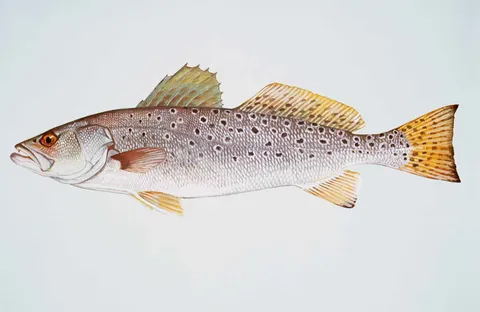
- Also known as speckled trout. Dark gray or green back fading to a silvery or white belly.
- Several black spots on the back extend onto the dorsal fins and the tail.
- A pair of large canine teeth at the tip of the upper jaw. No barbels on the lower jaw.
- FWC lists size up to 39 inches (17 pounds), common to 14 inches. The state record is 17 lb 7 oz, caught near Fort Pierce.
Fish it gets mixed up with
- Spotted seatrout vs. weakfish. Seatrout spots run onto the dorsal fin and tail. Weakfish have wavy lines that do not.
- Weakfish. Wavy lines of small, irregular dark spots on the upper sides, and a black tip on the tongue.
Where do seatrout feed in Florida, and when?
Spotted seatrout use coastal water over sand or seagrass, and FWC says you can target them in every major estuary. Spawning is inshore from March through November. In colder months they drop into deeper, still water. They eat baitfish, mullet, shrimp and crabs. FWC describes a live shrimp, or a small pinfish or pigfish, free-lined near the bottom, or those same baits drifted over grass under a float. Soft-bodied jigs, topwater poppers and spoons are on the list too. They're a soft fish. Get the ones you aren't keeping back in the water.
Lines that put you in a different seatrout region
Unofficial. FL Fish Rules is not FWC. Confirm the region on FWC's spotted seatrout page before you fish. The slot in every region is not less than 15 inches or more than 19 inches total length. FWC measures total length from the most forward point of the head, with the mouth closed, to the farthest tip of the tail with the tail compressed or squeezed, while the fish is lying on its side. In 2006 FWC clarified total length as a pinched tail and a closed mouth. Lay the tape in a straight line. A tape that follows the curve of the body reads long.
FWC's Feb. 4, 2026 news release said these nine regions would take effect April 1, 2026. The recreational slot and bags on that release match the recreational page. The same release prints a commercial slot of 15–24 inches, with no over-slot fish. That commercial slot is not the recreational slot in the table above.
The regulations page says the 2026 approach uses spawning potential ratio, relative abundance, habitat, harmful algal blooms, fishing effort, and stakeholder feedback. FWC says it will evaluate each region each year and post an Annual Review. Those reviews are not a second bag limit. Fish the table.
- Panhandle. Florida-Alabama line to 84°20.800′ W in Franklin County near Alligator Point. Ochlockonee Bay and the Ochlockonee River and its tributaries are not in the Panhandle.
- Big Bend. East of 84°20.800′ W and north of a line due east and due west from the westernmost point of Fred Howard Park Causeway (28°09.350′N, 82°48.398′W). All of Pinellas County north of 28°09.350′ N. Includes Ochlockonee Bay and the Ochlockonee, Withlacoochee, and Anclote rivers and their tributaries. Bag is 5.
- Tampa Bay. South of that Fred Howard Park point and north of the western terminus of State Road 64 in Manatee County. All of Manatee County north of State Road 64, and all of Hillsborough County. Includes the Alafia, Braden, Manatee, and Hillsborough rivers. Does not include Palma Sola Bay or the Anclote River.
- Sarasota Bay. South of Tampa Bay and north of 27°04.727′ N in Sarasota County. Manatee County south of State Road 64 and west of 82°22.500′ W, and Sarasota County west of 82°22.500′ W and north of 27°04.727′ N. Includes Palma Sola Bay, Phillippi Creek, Cow Pen Slough Canal, and Curry Creek. Does not include the Braden or Manatee rivers.
- Charlotte Harbor. South of Sarasota Bay and north of a line due west from 26°15.227′N, 81°49.412′W in Collier County. Collier County north of 26°15.227′ N, plus Manatee and Sarasota counties east and south of the Sarasota Bay region. Includes the Caloosahatchee, Myakka, and Peace rivers and their tributaries. Excludes Lake Okeechobee.
- Southwest. South of Charlotte Harbor, and Florida waters south of the Southeast region. Collier County south of 26°15.227′ N, all of Monroe County, and all of Everglades National Park.
- Southeast. South of the Martin-Palm Beach county line and north of the Miami-Dade/Monroe county line. Includes the Loxahatchee River and its tributaries, Hillsboro Canal, Miami Canal, North New River Canal, and West Palm Beach Canal. Excludes Lake Okeechobee and Everglades National Park. Special regulations apply in Biscayne National Park.
- Indian River Lagoon. South of a line due east from 29°01.755′N, 80°54.160′W in Volusia County, and north of the Martin-Palm Beach county line. Inside waters of Volusia County south of Lytle Avenue/South Causeway (State Road A1A), and Volusia County south of State Road 44 and east of I-95. Includes the Kissimmee River, Cypress Lake, Lake Hatchineha, Lake Kissimmee, and Lake Okeechobee. Excludes the Loxahatchee River and the St. Johns River. Closed November 1 through December 31. You may not possess a fish larger than 19 inches. Bag is 2.
- Northeast. South of the Florida-Georgia line and north of the Indian River Lagoon region, including Volusia County north and west of that region. Includes the St. Johns River and its tributaries. Excludes the Withlacoochee River, the Kissimmee River, Cypress Lake, Lake Hatchineha, and Lake Kissimmee. You may not possess a fish larger than 19 inches. Bag is 3.
Regions on this site
- Panhandle & Emerald Coast fishing rules
- Tampa Bay fishing rules
- Sarasota & Southwest fishing rules
- Florida Keys fishing rules
- Jacksonville & Northeast fishing rules
- Southeast & Treasure Coast fishing rules
- Spotted seatrout regions 2026
- Seatrout vs. weakfish
- How to measure fish
- Weakfish limits
- Saltwater fishing license
- Shoreline license and kayaks
- Unregulated species default bag
- 2026 closed seasons calendar
- Open now and closing soon
- What to catch by month
Common questions
What is the spotted seatrout size limit?
Not less than 15 inches or more than 19 inches total length in every region.
Can you keep a seatrout over 19 inches?
In most regions, one fish over 19 inches per vessel, or one per person if you are fishing from shore, included in the bag. In the Northeast and Indian River Lagoon regions you may not possess a fish larger than 19 inches total length.
What is the seatrout bag limit?
Five fish per person per day in the Big Bend, two in the Indian River Lagoon, and three in the other regions.
When is spotted seatrout closed?
The Panhandle is closed in February and open March 1 through January 31. The Indian River Lagoon is closed November 1 through December 31 and open January 1 through October 31. Other regions are open year-round.
How do you tell a spotted seatrout from a weakfish?
Seatrout have black spots that extend onto the dorsal fins and tail. FWC's seatrout profile says weakfish have irregular wavy lines instead of those spots. FWC's weakfish profile adds a black tip on the tongue and yellowish pelvic and anal fins.
What gear can you use for spotted seatrout?
Hook and line and cast net. FWC says you cannot harvest using any multiple hook in conjunction with live or dead natural bait, and snatching is prohibited. The fish must remain in whole condition until landed ashore. For-hire captain and crew may not keep a bag limit while on a for-hire trip.
How do you read the spotted seatrout limit table?
The size cell is not less than 15 inches or more than 19 inches total length on every row. The bag cell is the split: 3 per day on most rows, 5 on the Big Bend row, and 2 on the Indian River Lagoon row. Northeast and the Lagoon also say you may not possess a fish larger than 19 inches. The other rows allow one fish over 19 inches per vessel, or per person from shore, and that fish is included in the bag. The season cell is closed in February on the Panhandle row, open March 1 through January 31. The Lagoon row is closed November 1 through December 31. The other rows are open year-round. State waters are from shore to 3 miles in the Atlantic and from shore to 9 miles in the Gulf.
What does the fish over 19 inches mean in the bag column?
On the rows that allow it, that one fish over 19 inches is included in the bag. It is not an extra fish. Those rows are Panhandle, Big Bend, Tampa Bay, Sarasota Bay, Charlotte Harbor, Southwest and Southeast. The Northeast and Indian River Lagoon rows do not allow it. They say you may not possess a fish larger than 19 inches total length.