Spotted seatrout vs. weakfish: identification and limits
On this page
The numbers, briefly
- Fastest ID
- Spots on dorsal fin and tail = spotted seatrout; no spots on those fins = weakfish
- Seatrout limit
- 15–19" slot; 2–5/day by region
- Weakfish limit
- Weakfish Mgmt Zone (Nassau Co.): 12" min, 1/day. Elsewhere: no min, 100 lb/person
- Permits
- Saltwater license unless exempt
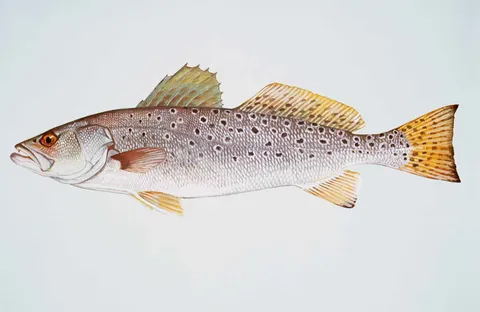

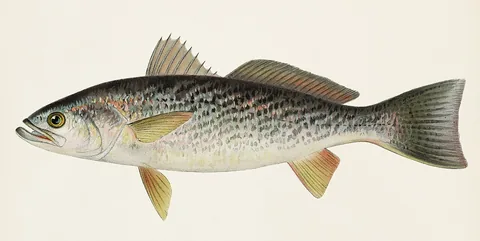

Side-by-side
| Feature | Spotted seatrout | Weakfish |
|---|---|---|
| Spots | Distinct round black spots on back | Small irregular dark spots in wavy lines on upper sides |
| Spots on dorsal fin & tail? | Yes | No |
| Fin color | Not given on the profile | Pelvic and anal fins yellowish |
| Tongue | Not given on the profile | Tip black |
| Teeth | Pair of large canines at tip of upper jaw | Pair of large canines at tip of upper jaw |
| Range in FL | Every major estuary | Atlantic coast. Profile: typically not in the Gulf, possibly the extreme southeastern Gulf. Majority of genetically-pure fish: the Nassau County zone |
| Sand seatrout and hybrids | Not this rule | Included. FWC calls them weakfish-like fish |
| Size limit | 15–19" total length slot (recreational, statewide) | 12" total length min in Weakfish Mgmt Zone; none elsewhere |
| Bag | 3 in most regions; Big Bend 5; Indian River Lagoon 2 | 1 in Weakfish Mgmt Zone; 100 lb elsewhere |
| Gear | Hook and line; cast net. No multiple hook with natural bait. No snatching. | Hook and line; cast net |
Unofficial. FL Fish Rules is not FWC. Confirm seatrout on FWC's spotted seatrout page and weakfish on FWC's weakfish page before you fish.
Sand seatrout count under the weakfish rule
FWC's weakfish page says the regulations include weakfish-like fish such as sand seatrout and hybrids of the two. The management history dates the Weakfish Management Zone to July 27, 2010. FWC drew the zone in part of Nassau County because of the difficulty distinguishing weakfish, sand seatrout, and weakfish-sand seatrout hybrids, and cut the recreational bag after an Atlantic States Marine Fisheries Commission assessment that the weakfish population along the entire Atlantic coast is severely depleted. FWC says this area is where the majority of genetically-pure weakfish occur in Florida.
The sand seatrout profile still lists marks, and it also calls them white trout. The body is pale, with a tan or yellowish back fading to a silver or white belly. The inside of the mouth is yellow. They have 10 to 12 soft anal-fin rays, large canine teeth at the tip of the upper jaw, and no dark spots and no barbels. FWC says they are usually less than 15 inches (1 pound), live over sand bottoms in the Gulf of Mexico, and are rare in Atlantic waters. The profile says sand seatrout are not currently eligible for a state record. The weakfish profile's similar-species line says silver seatrout, C. nothus, have a tail whose bottom half is longer than the upper half.
Seatrout gear and the commercial slot
Allowable gear for spotted seatrout is hook and line and cast net. FWC prohibits harvest with any multiple hook in conjunction with live or dead natural bait, and prohibits snatching. The fish must remain in whole condition until landed ashore. For-hire captain and crew may not keep a bag limit while on a for-hire trip. Weakfish allowable gear is hook and line and cast net. The weakfish page does not print the multiple-hook line. Both fish are total length: mouth closed, tail compressed or squeezed, fish on its side.
The recreational seatrout slot is 15–19 inches total length. In most regions one fish over 19 inches is allowed per vessel, or per person from shore, and it counts in the bag. Northeast and Indian River Lagoon allow none. FWC's Feb. 4, 2026 news release, which set the nine regions to take effect April 1, 2026, also prints a commercial slot of 15–24 inches with no over-slot fish. That commercial slot is not the recreational rule.
Spotted seatrout limits · Weakfish limits · Seatrout regions · How to measure
Check these first
- Tail and second dorsal first. Spots there mean spotted seatrout.
- A pale trout with no spots and a yellow mouth can be a sand seatrout. In the Nassau zone it still counts as the one weakfish-type fish, and it has to be 12" total length or better.
- In Nassau County's Weakfish Management Zone, keep only 1 weakfish-type fish, and it has to be 12" or better.
- A seatrout over 19" goes back in the Northeast and in the Indian River Lagoon.
- No multiple hook with live or dead natural bait on seatrout, and no snatching. The fish must remain in whole condition until landed ashore.
How to get the permit
- Saltwater license, unless you're exempt.
- Know the seatrout region before you keep one.
Straight answers
How do you tell spotted seatrout from weakfish?
Check the fins. Spotted seatrout have bold round black spots that run onto the dorsal fins and tail. Weakfish have small irregular dark spots in wavy lines on the upper sides that do not carry onto those fins. Weakfish also have yellowish pelvic and anal fins and a black-tipped tongue. Sand seatrout, which FWC also calls white trout, have no dark spots. The weakfish rule still covers them.
What are the weakfish limits in Florida?
Inside the Weakfish Management Zone in Nassau County: 12 inches total length minimum, 1 per person. In other state waters there is no minimum size and the bag is 100 pounds per person. These rules also cover sand seatrout and weakfish/sand seatrout hybrids.
Where is the Weakfish Management Zone?
State waters from the Florida–Georgia line to the southern tip of Amelia Island, plus the inland waters of Nassau County and the St. Marys River and tributaries east of Highway 17, north of SR 200A and north of the Shave Bridge on the Amelia River. FWC dates that zone to July 27, 2010, and says it is where the majority of genetically-pure weakfish occur in Florida.
What are the spotted seatrout limits?
A 15–19 inch total-length slot statewide, with bag limits of 2 to 5 depending on the region. That is the recreational slot. FWC's Feb. 4, 2026 news release also prints a commercial slot of 15–24 inches. See our 2026 seatrout regions page for the recreational regions.
Do sand seatrout have their own bag?
Not on the weakfish page. FWC says the regulations include weakfish-like fish such as sand seatrout and hybrids of the two. The zone was drawn because those fish are hard to tell apart. The sand seatrout profile still lists marks: pale body, yellow inside the mouth, 10 to 12 soft anal-fin rays, and no dark spots.