Weakfish limits and the Nassau County zone
On this page
Varies by region
- Zone size12" total length
- Zone bag1 fish per person
- SeasonNot listed
Weakfish in the Weakfish Management Zone: 12 inches total length and 1 fish per person. In other Florida state waters there is no minimum size and the bag is 100 pounds per person. The same rules cover sand seatrout and hybrids of weakfish and sand seatrout. The FWC page does not list a season. Legal gear is hook and line and cast net.
Short version
- Zone size
- 12" total length
- Zone bag
- 1 fish per person
- Other state waters
- No minimum size, 100 pounds per person
- Season
- Not listed
- Gear
- Hook and line; cast net

Weakfish limits
| Waters | Size | Bag | Season |
|---|---|---|---|
| Weakfish Management Zone | 12" total length | 1 fish per person | Not listed |
| State waters outside the Weakfish Management Zone | None | 100 pounds per person | Not listed |
How do you tell a weakfish?
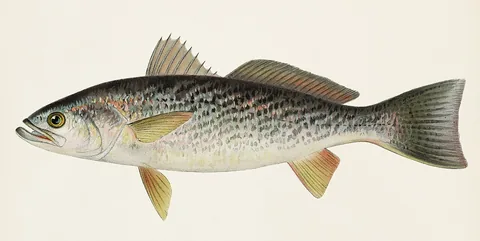
- Cynoscion regalis. Dark olive or blue-green back fading to silvery sides and belly.
- Upper sides have wavy lines of small, irregular, dark spots. Pelvic and anal fins are yellowish. Other fins are paler.
- A pair of large canine teeth at the tip of the upper jaw. The tip of the tongue is black. No barbels on the lower jaw.
- FWC lists them common to 20 inches. The state record is 10 lb, caught near Port Canaveral.
- Sand seatrout, which the FWC profile also calls white trout: pale body, tan or yellowish back, yellow inside the mouth, 10 to 12 soft anal-fin rays, no dark spots, no barbels. Usually less than 15 inches (1 pound). The weakfish regulations include them and the hybrids.
- FWC's weakfish profile names silver seatrout, C. nothus, by the tail: the bottom half is longer than the upper half. Sand seatrout lack dark spots.
Seatrout, side by side
- Spotted seatrout vs. weakfish. Seatrout spots run onto the dorsal fin and tail. Weakfish have wavy lines of small spots on the upper sides. Sand seatrout have no dark spots, and the weakfish bag still covers them.
- Spotted seatrout. Seatrout spots run onto the dorsal fin and tail. Weakfish have wavy lines of small dark spots on the upper sides.
Where does the weakfish rule apply in Florida?
FWC's profile calls weakfish an Atlantic coast fish, typically not in the Gulf of Mexico, and the fishing-tips line says they are possibly found in the extreme southeastern Gulf. Juveniles use estuaries. Adults move inshore and north in warm months, in the surf, inlets, channels and estuaries, and offshore and south in cold months. They may mature as early as age 1, spawn in nearshore or estuarine water between April and October, and eat shrimp and fish. Northeast inlets are the water next to the management zone. Sand seatrout, on their own profile, live over sand bottoms in the Gulf and are rare in Atlantic waters.
How FWC measures a weakfish
Unofficial. FL Fish Rules is not FWC. Confirm the zone on FWC's weakfish page before you fish. Weakfish are on FWC's total-length list. Total length runs from the most forward point of the head, mouth closed, to the farthest tip of the tail with the tail compressed or squeezed, fish lying on its side. In 2006 FWC clarified that as a pinched tail and a closed mouth.
The weakfish page does not list a season. Do not read the empty season as open year-round. It lists size and bag by zone only.
Piers and bridges on this site
- Jacksonville Beach Fishing Pier, Jacksonville Beach (Duval County)
- St. Johns County Ocean Pier, St. Augustine Beach (St. Johns County)
- Sebastian Inlet State Park (jetties), Melbourne Beach (Brevard/Indian River counties)
- Fort Pierce Inlet State Park, Fort Pierce (St. Lucie County)
Regions on this site
- Panhandle & Emerald Coast fishing rules
- Tampa Bay fishing rules
- Sarasota & Southwest fishing rules
- Florida Keys fishing rules
- Jacksonville & Northeast fishing rules
- Southeast & Treasure Coast fishing rules
- Seatrout vs. weakfish
- Spotted seatrout
- How to measure fish
- Jacksonville and Northeast rules
- 2026 closed seasons calendar
- Open now and closing soon
- What to catch by month
Questions and answers
What is the weakfish limit in Nassau County?
Inside the Weakfish Management Zone, 12 inches total length and 1 fish per person. The zone runs from the Florida-Georgia line to the southernmost tip of Amelia Island and includes the inland waters of Nassau County and the St. Marys River tributaries described on the FWC page.
What is the weakfish limit outside that zone?
No minimum size and 100 pounds per person in other Florida state waters.
Do sand seatrout count as weakfish?
FWC says the regulations include weakfish-like fish such as sand seatrout and hybrids of the two. The sand seatrout profile calls them white trout: no dark spots, yellow inside the mouth, 10 to 12 soft anal-fin rays, usually less than 15 inches. The profile says they are not currently eligible for a state record.
Why did FWC create the Weakfish Management Zone?
The weakfish page dates the rule to July 27, 2010. FWC created the zone in part of Nassau County to address the difficulty distinguishing weakfish, sand seatrout, and weakfish-sand seatrout hybrids. FWC also decreased the recreational bag after an Atlantic States Marine Fisheries Commission assessment that the weakfish population along the entire Atlantic coast is severely depleted.
Does the weakfish page list a season?
No. It lists size and bag by zone and does not list a season.
What gear is legal?
Allowable gear on the weakfish page: hook and line and cast net.