Wahoo size, bag and season in Florida
On this page
Open year-round
- SizeNone
- Bag2 per person on the recreational page
- SeasonOpen year-round
Wahoo have no minimum size: the bag is 2 per person, and the season is open year-round. The FWC wahoo page states those limits and doesn't split Gulf from Atlantic. The profile describes them as offshore fish, generally not in schools, caught by trolling.
The numbers, briefly
- Size
- None
- Bag
- 2 per person on the recreational page
- Season
- Open year-round
- Gear on that page
- Not listed

Wahoo limits
| Waters | Size | Bag | Season |
|---|---|---|---|
| Florida, as listed on the FWC wahoo page | None | 2 per person | Open year-round |
2 per person on the page, 2 per harvester in the rule
The recreational wahoo page does not split Gulf from Atlantic. Minimum size limit: none. Daily bag limit: 2 per person. Season: open year-round. It does not list legal gear. Rule 68B-57.004 says a recreational harvester may not harvest or land per day from Florida Waters, or possess in or on Florida Waters, more than 2 wahoo. Same number. The page says per person. The rule says recreational harvester.
The vessel limit in that rule is commercial: a commercial harvester may not harvest or possess more than 500 pounds of wahoo per day, and the commercial harvesters aboard a vessel may not collectively possess more than 500 pounds. That 500-pound line is not a recreational boat cap. This site is unofficial. Confirm the MyFWC wahoo page before you fish.
Landed whole, except fillets from the Bahamas
Rule 68B-57.003 says a person harvesting wahoo shall land each wahoo in whole condition, except as that rule provides. You may not possess in or on Florida Waters a wahoo that has been beheaded, sliced, divided, filleted, ground, skinned, scaled, or deboned. The rule says this will not be construed to prohibit evisceration (gutting) of a wahoo, or removal of gills from a wahoo.
The exception is for recreational anglers who lawfully harvested wahoo in the Bahamas. Skin must remain intact on the entire fillet of any wahoo carcass. Two fillets of wahoo, regardless of the length of each fillet, are equivalent to one fish. Valid Bahamian fishing and cruising permits have to be on board. Each person needs a valid government passport with current stamps and dates from the Bahamas. The vessel has to be on a direct and continuous course through state waters, and no one aboard fishes in state waters. Terminal gear (hook, leader, sinker, flasher, or bait) used with an automatic reel, bandit gear, buoy gear, handline, or rod and reel must be disconnected and stowed separately from such fishing gear. Sinkers must be disconnected from the down rigger and stowed separately.
The recreational wahoo page links Bringing Fish Back to Florida from The Bahamas. That page says only dolphin, wahoo, and reef fish may come back as fillets, the skin must remain on the entire fillet, and two fillets count as one fish toward the bag. Fish brought into the U.S. cannot be sold. The same page's verb is printed "brough." The rule's whole-condition exception is the wahoo-specific list. Our Bahamas transport page is the longer write-up.
Long first dorsal, wavy bars
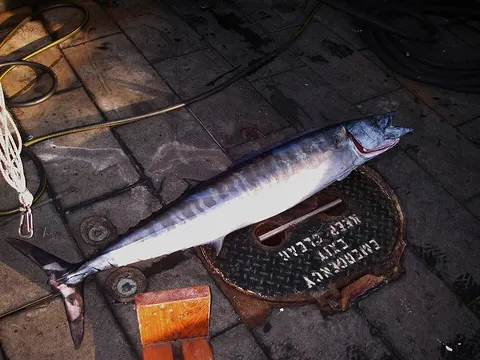
The wahoo profile: slender body, dark bluish-green back, silvery sides, whitish belly, and 24 to 30 wavy, dark blue bars. Jaws elongated into a pointed beak, with triangular finely-serrated teeth. The first dorsal fin is low and long. Similar species on that profile: king mackerel, S. cavalla, because the lateral line drops sharply. The king profile says the same thing from the other side, and it spells the wahoo name A. solandri. The wahoo profile heading spells Acanthocybium solanderi. Rule 68B-57.002 spells Acanthocybium solandri.
That definitions rule opens with the words "As used in Chapter 68B-41, F.A.C." Chapter 68B-57 is the wahoo chapter. The sentence is quoted as printed. The profile puts wahoo offshore, generally not in schools, known for tremendous runs and shifts of direction, feeding on fishes and squid, and caught by trolling bait and artificial lures on flatlines.
How do you tell a wahoo from a kingfish?
- Slender body with a dark bluish-green back, silvery sides and a whitish belly, and 24 to 30 wavy, dark blue bars on the sides.
- Jaws elongated, forming a pointed beak, with triangular finely-serrated teeth.
- First dorsal fin is low and long. The king profile calls that fin long and continuous, and separates wahoo from a king by the king's lateral line, which drops sharply.
- Profile size: up to 98 inches. State record: 139 lb, caught near Marathon. The profile heading spells the name Acanthocybium solanderi. Rule 68B-57.002 spells it Acanthocybium solandri.
King mackerel, side by side
- King mackerel. Lateral line drops sharply below the second dorsal fin, and the minimum is 24 inches fork length.
- King vs. Spanish mackerel. Wahoo is the third fish on that page. The king profile lists wahoo by the long, continuous first dorsal fin.
Where do wahoo run off Florida?
Offshore waters, and generally not in schools. Known for tremendous runs and shifts of direction. They feed on fishes and squid. Caught by trolling bait and artificial lures on flatlines. The recreational page does not list a pier fishery and does not list legal gear.
Regional limit pages
- Panhandle & Emerald Coast fishing rules
- Tampa Bay fishing rules
- Sarasota & Southwest fishing rules
- Florida Keys fishing rules
- Jacksonville & Northeast fishing rules
- Southeast & Treasure Coast fishing rules
- King mackerel
- King vs. Spanish mackerel
- Fish brought back from the Bahamas
- Billfish, tuna and swordfish
- How to measure fish
- Saltwater fishing license
- 2026 closed seasons calendar
- Open now and closing soon
- What to catch by month
Straight answers
What is the wahoo size limit?
The recreational page says none. Rule 68B-57.004 does not add a minimum size.
What is the wahoo bag limit?
2 per person on the recreational page. Rule 68B-57.004 says a recreational harvester may not harvest, land, or possess more than 2 wahoo per day. The 500-pound line in that rule is the commercial vessel limit.
Is wahoo open year-round?
Yes. The recreational page lists the season as open year-round. It does not split Gulf from Atlantic.
How do you tell a wahoo from a king mackerel?
Wahoo have a low, long first dorsal fin and 24 to 30 wavy, dark blue bars. King mackerel have a lateral line that drops sharply below the second dorsal fin, and a 24-inch fork-length minimum.
Can you bring wahoo fillets back from the Bahamas?
Rule 68B-57.003 requires wahoo landed in Florida to be in whole condition, and it exempts recreational anglers who lawfully harvested them in the Bahamas if the skin stays intact on the entire fillet, two fillets count as one fish, Bahamian fishing and cruising permits are aboard, each person has a passport with current Bahamian stamps, and the boat is in direct transit with terminal gear disconnected and stowed. The FWC Bahamas page, which the wahoo recreational page links, says only dolphin, wahoo, and reef fish may come back as fillets.