Spot and Atlantic croaker limits in Florida
On this page
Open year-round
- Atlantic sizeNone
- Atlantic bag50 per person per species, effective since Dec. 1, 2021
- SeasonOpen year-round
Spot and Atlantic croaker in Atlantic state waters from Nassau County through Miami-Dade County, excluding Monroe County: no minimum size and 50 per person per species. FWC says that bag has been in effect since December 1, 2021. Gulf state waters, including Monroe County, have no minimum size and a bag of 100 pounds per person. Both coasts are open year-round. The Atlantic bag is per species.
What you need in one box
- Atlantic size
- None
- Atlantic bag
- 50 per person per species, effective since Dec. 1, 2021
- Atlantic waters
- Nassau through Miami-Dade, excluding Monroe County
- Gulf bag
- 100 pounds per person, including Monroe County
- Season
- Open year-round
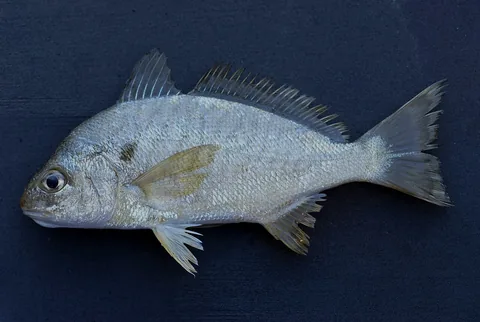

Spot and Atlantic croaker limits
| Waters | Size | Bag | Season |
|---|---|---|---|
| Atlantic state waters, Nassau through Miami-Dade, excluding Monroe County | None | 50 per person per species, effective since Dec. 1, 2021 | Open year-round |
| Gulf state waters, including Monroe County | None | 100 pounds per person | Open year-round |
How do you tell a spot from an Atlantic croaker?
- Spot, Leiostomus xanthurus, on the FWC profile: bluish-brown back fading to brassy sides and a silvery-white belly, a dark spot behind the gill cover, and 12 to 15 dark diagonal lines on the upper sides. FWC calls spot the only drum in Florida with a forked tail.
- Atlantic croaker, Micropogonias undulatus, on the FWC profile: silvery-gray or bronze body, iridescent on the head, indistinct wavy bars on the upper sides, a strongly serrated preopercle, and small barbels on the lower jaw. The profile says they turn bronze or yellow when spawning.
- The spot profile says Atlantic croaker have a strongly serrated preopercle. The croaker profile says spot have a forked tail and a smooth preopercle.
- The regulations page does not print those marks, a gear list, or a minimum size. It sets one size and bag structure for both species. On the Atlantic the bag is 50 per person per species. Monroe County is excluded from the Atlantic block and included in the Gulf block.
- Profile sizes, not size limits: spot up to 14 inches. Atlantic croaker up to 20 inches (4 pounds). The croaker state record is 4 lbs 15 oz, caught near St. Lucie. The profile says longevity is 2 to 4 years.
Drums with their own bag
- Spotted seatrout. Seatrout have their own slot and regional bag. Spot and Atlantic croaker use the bag on this page.
- Weakfish. Weakfish use a Nassau County zone rule and a separate bag in other state waters.
Which Florida waters use which bag?
The regulations page does not describe habitat. It does name the waters: Atlantic state waters from Nassau County through Miami-Dade County, excluding Monroe, and Gulf state waters including Monroe County. Piers on both coasts are in those state waters. Use the Atlantic 50-fish per-species bag or the Gulf 100-pound bag for the county you are fishing. FWC's Atlantic croaker profile says the fish is generally found north of Tampa Bay on the west coast and north of Cape Canaveral on the east coast. Young croaker use estuaries. Older fish, which the profile puts at 2 to 3 years, use deep offshore water in winter and bays and estuaries in spring, summer, and fall. They spawn offshore in fall and eat fishes and invertebrates. The spot profile says spot use coastal waters and eat invertebrates and decaying material. That range note does not change the bag.
What the regulations page leaves out
Unofficial. FL Fish Rules is not FWC. Confirm the bag on FWC's spot and Atlantic croaker page before you fish. That page prints no gear list and no minimum size. FWC's measurement page names total-length species and fork-length species. Spot and Atlantic croaker are not on either list. With no minimum, there is no length method to apply to a keeper.
Pier and bridge pages
- Jacksonville Beach Fishing Pier, Jacksonville Beach (Duval County)
- St. Johns County Ocean Pier, St. Augustine Beach (St. Johns County)
- Sebastian Inlet State Park (jetties), Melbourne Beach (Brevard/Indian River counties)
- Fort Pierce Inlet State Park, Fort Pierce (St. Lucie County)
- Skyway Fishing Pier State Park, St. Petersburg / Tampa Bay
- Fort De Soto Park Gulf & Bay Piers, Tierra Verde (Pinellas County)
- Navarre Beach Pier, Navarre Beach (Santa Rosa County)
- Russell-Fields City Pier, Panama City Beach (Bay County)
- Naples Pier, Naples (Collier County)
Regional limit pages
- Panhandle & Emerald Coast fishing rules
- Tampa Bay fishing rules
- Sarasota & Southwest fishing rules
- Florida Keys fishing rules
- Jacksonville & Northeast fishing rules
- Southeast & Treasure Coast fishing rules
- Spotted seatrout
- Weakfish
- Black drum
- 2026 closed seasons calendar
- Open now and closing soon
- What to catch by month
If the rule isn't clear
What is the Atlantic limit for spot and for croaker?
From Nassau County through Miami-Dade County, excluding Monroe County: no minimum size and 50 per person per species. FWC says that bag has been effective since December 1, 2021. The season is open year-round.
What is the Gulf limit?
Gulf state waters, including Monroe County: no minimum size and 100 pounds per person. The season is open year-round.
Does Monroe County use the Atlantic bag?
No. FWC excludes Monroe County from the Atlantic block and includes it in the Gulf block.
Is the Atlantic 50-fish bag shared by both species?
FWC prints it as 50 per person/per species, so each species has that bag. The line says it has been effective since Dec. 1, 2021.
How do you tell a spot from an Atlantic croaker?
Spot have a forked tail, a dark spot behind the gill cover, and 12 to 15 diagonal lines on the upper sides. FWC says spot are the only drum in Florida with a forked tail. Atlantic croaker have a strongly serrated preopercle and small barbels on the lower jaw. The regulations page does not print those marks.