Florida pompano size, bag and season
On this page
Open year-round
How many Florida pompano you can keep: 6 per harvester at 11 inches fork length, not total length, open year-round on the Gulf and the Atlantic, in state and federal waters. Gear is hook and line, cast net, and beach or haul seine. African pompano are 24 inches fork length, 2 per harvester, and no more than 2 per vessel.
What you need in one box
- Measure
- Fork length, to the center of the tail fork. Total length is a different measurement.
- Gulf
- 11" fork length, 6 per harvester, open year-round
- Atlantic
- 11" fork length, 6 per harvester, open year-round
- Gear
- Hook and line, cast net, beach or haul seine
- African pompano
- 24" fork length, 2 per harvester, no more than 2 per vessel, open year-round
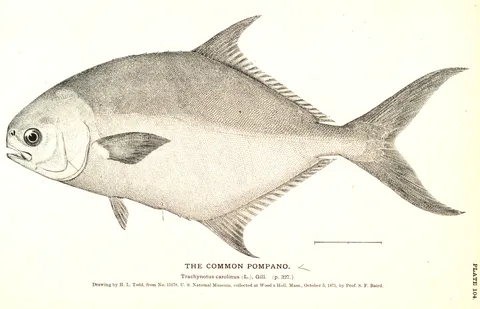

Florida pompano limits
| Waters | Size | Bag | Season |
|---|---|---|---|
| Gulf state and federal waters | 11" fork length | 6 per harvester | Open year-round |
| Atlantic state and federal waters | 11" fork length | 6 per harvester | Open year-round |
| African pompano, Gulf and Atlantic, state and federal | 24" fork length | 2 per harvester. No more than 2 per vessel | Open year-round |
What does a Florida pompano look like?
- Dark greenish-gray back shading to silver sides, often with yellow on the belly. Fish from dark water may show yellow on the throat, pelvic fins and anal fin.
- The dorsal fin begins in front of the anal fin. Dorsal, anal and tail fins are short and upright. Permit have a dorsal fin that begins over the anal fin, and those fins are long and swept back.
- The forehead slopes gently backward. The body is deep and compressed, with a small mouth. The tail fork is wider than a permit's.
- The species profile lists Florida pompano up to 24 inches (8 pounds), and the state record 8 lb 4 oz, caught near Port St. Joe. The ID sheet says up to 25 inches and 8 pounds. The research identification page says up to 25 inches fork length, common to 6 pounds and may reach 8. That page counts 22 to 27 dorsal soft rays and 20 to 23 anal soft rays, and says pompano have no teeth on the tongue at any size.
- African pompano, Alectis ciliaris, have a steep rounded head, and the dorsal fin starts in front of the anal fin. Juveniles have long threadlike rays on the front of the dorsal and anal fins. The ID sheet shows 4 or 5 narrow bars on juveniles only, and hardened scutes ahead of the tail. The profile says up to 42 inches (40 pounds) and lists scutes on the side in front of the tail. The ID sheet says up to 42 inches and 50 pounds.
- Palometa, Trachinotus goodei, are on the same ID sheet: very long dorsal and anal fins, 4 narrow bars on juveniles and adults, bright silver sides, up to 20 inches and 1 pound. The MyFWC permit page does not print a palometa size or bag.
The permit mix-up
- Permit vs. pompano. Dorsal fin ahead of the anal fin is pompano; dorsal fin over the anal fin is permit.
- Permit. Permit grow much larger, the dorsal fin starts over the anal fin, and the forehead rises into a hump. Small permit show orange on the chin, fins, or belly. Pompano show yellow there.
- Palometa. Very long dorsal and anal fins, and 4 narrow bars that stay on adults. The permit regulations page does not print a palometa bag.
Where do pompano run on the Florida coast?
Florida pompano use inshore and nearshore water, especially sandy beaches, oyster bars and seagrass, often where the water is turbid. FWC says they're found as deep as 130 feet. They spawn offshore from March to September and eat mollusks and crustaceans, sand fleas in particular. They slide with the tide, and the season's movement follows the temperature. Beach piers match that sandy-beach water. Measure fork length, not total length. African pompano juveniles are in open water. Adults school over reefs, wrecks, and ledges, and the profile says they are found to 180 feet.
Pier pages that match the habitat
- Skyway Fishing Pier State Park, St. Petersburg / Tampa Bay
- Fort De Soto Park Gulf & Bay Piers, Tierra Verde (Pinellas County)
- Venice Fishing Pier, Venice
- Naples Pier, Naples (Collier County)
- Jacksonville Beach Fishing Pier, Jacksonville Beach (Duval County)
- St. Johns County Ocean Pier, St. Augustine Beach (St. Johns County)
- Navarre Beach Pier, Navarre Beach (Santa Rosa County)
- Russell-Fields City Pier, Panama City Beach (Bay County)
Which region pages apply
- Panhandle & Emerald Coast fishing rules
- Tampa Bay fishing rules
- Sarasota & Southwest fishing rules
- Florida Keys fishing rules
- Jacksonville & Northeast fishing rules
- Southeast & Treasure Coast fishing rules
- Permit vs. pompano
- Permit
- How to measure fish
- Biscayne National Park
- Fishing piers
- Sheepshead
- Bag limits on a pier
- Reef fish gear
- State Reef Fish Survey
- 2026 closed seasons calendar
- Open now and closing soon
- What to catch by month
Questions anglers ask
How many Florida pompano can you keep?
6 per harvester per day, at 11 inches fork length, open year-round. FWC prints one rule for state and federal waters. This page repeats it on a Gulf line and an Atlantic line. Measure fork length, from the tip of the snout to the center of the tail fork. African pompano, on the same FWC page, are 24 inches fork length, 2 per harvester, and no more than 2 per vessel, also open year-round.
What is the Florida pompano size limit?
11 inches fork length, and the bag is 6 per harvester. The season is open year-round. Fork length is not total length. The MyFWC recreational page does not print a recreational maximum. Rule 68B-35.003 sets a commercial size that is different: not less than 11 inches and not greater than 20 inches fork length. The table on this page is the recreational rule.
What gear can you use for pompano?
The MyFWC page allows hook and line, a cast net, and a beach or haul seine. Rule 68B-35.004 names those three and prohibits other gear for a harvest or an attempted harvest, aside from the commercial Pompano Endorsement exception in that rule. A multiple hook used with live or dead natural bait is prohibited. Snagging (snatch hooking) is prohibited. Rule 68B-35.002 defines that as intentionally hooking or impaling the fish anywhere but the mouth.
What is the African pompano limit?
24 inches fork length, 2 per harvester, and no more than 2 per vessel. The season is open year-round. State waters allow hook and line only. Federal waters allow hook and line and spearing. The profile says African pompano reach 42 inches (40 pounds). The ID sheet says 42 inches and 50 pounds. Those are size descriptions, not a second minimum.
How do you tell a pompano from a permit?
On a Florida pompano the dorsal fin begins in front of the anal fin, and the fins are short and upright. On a permit the dorsal fin begins over the anal fin, and the dorsal and anal fins are long and swept back. FWC's research identification page counts 22 to 27 dorsal soft rays and 20 to 23 anal soft rays on a Florida pompano, and 17 to 21 dorsal and 16 to 19 anal on a permit. That page says pompano have no teeth on the tongue at any size, and small permit do. FWC's life-history page says small permit show orange on the chin, fins, or belly, and pompano show yellow there.
Can you fillet a pompano before you land it?
Rule 68B-35.003 says pompano, African pompano, and permit have to be landed in whole condition. Gutting, and removing the gills, is allowed before landing. Possessing a fish that has been deheaded, sliced, divided, filleted, ground, skinned, scaled, or deboned is prohibited on the water, on a public or private fishing pier, on a bridge or a catwalk attached to a bridge where fishing is allowed, and on a jetty. Land means bringing the harvested fish ashore.
Does Biscayne National Park change the pompano limit?
The park page puts Florida pompano and African pompano in a 10-fish recreational aggregate per person for harvest inside the park, effective July 1, 2020. The species bag still applies: 6 Florida pompano, or 2 African pompano and no more than 2 per vessel. Transit of the listed aggregate species over 10 fish is not allowed. The park's increased minimum-size list does not name pompano or African pompano.
Is this page official?
No. This site is unofficial. It is not FWC. The recreational size, bag, and season lines were read from the MyFWC permit page on October 31, 2026, and they match the table. Confirm the current rule on MyFWC before you fish.