Permit vs. pompano: identification and limits
On this page
The short version
- Fastest ID
- Dorsal starts ahead of anal fin = pompano; dorsal starts over anal fin = permit
- Pompano limit
- 11" fork length min, 6/day, year-round
- Permit limit
- Outside SPZ: 11–22" FL slot (1 over 22"), 2/day. SPZ: 22" min, 1/day, closed Apr 1–Jul 31
- Permits
- Saltwater license unless exempt
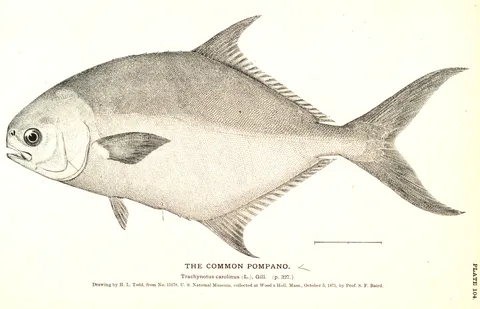

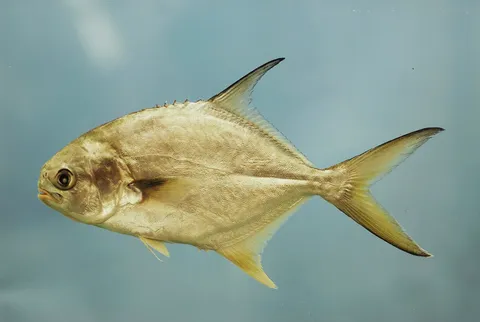

Side-by-side
| Feature | Florida pompano | Permit |
|---|---|---|
| Dorsal fin start | Ahead of the anal fin | Directly over the anal fin |
| Dorsal fin shape | Short, upright | Long, swept back |
| Anal fin | Short | Long, swept back |
| Forehead | Slopes back gently | Rises steeply into a hump, then slopes back |
| Tail | More upright, wide fork | Swept back, narrow fork |
| Color | Silver with darker back; yellow on belly common | Orange-yellow belly; juveniles may show orange on belly/pelvic/anal fins |
| Other mark | No teeth on the tongue at any size | May have a black spot behind the pectoral fin. Small permit have teeth on the tongue |
| Dorsal soft rays | 22 to 27 | 17 to 21 |
| Anal soft rays | 20 to 23 | 16 to 19 |
| Small-fish color | Yellow on the throat, pelvic fins, anal fin, or belly | Orange on the chin, fins, or belly |
| Species profile size | Up to 24 in (8 lb). State record 8 lb 4 oz, near Port St. Joe | Common to 50 lb. State record 56 lb 2 oz, near Fort Lauderdale |
| ID sheet size | Up to 25 in and 8 lb | Up to 45 in and 50 lb |
| Research ID page size | Up to 25 in fork length. Common to 6 lb, may reach 8 | Up to 48 in fork length. Common to 40 lb, may reach 50 |
| Size limit | 11" FL minimum | Outside SPZ: 11–22" FL slot; SPZ: 22" FL minimum |
| Bag | 6 per harvester | Outside SPZ: 2 (1 may exceed 22"); SPZ: 1 (2/vessel) |
| Season | Year-round | Outside SPZ: year-round; SPZ: closed Apr 1–Jul 31 |
| Gear | Hook and line, cast net, beach or haul seine | State waters: hook and line only. Federal waters: hook and line and spearing |
Diagram: where the fins start
The Special Permit Zone closure, April 1 through July 31, is the season text on the permit page. That row is on the Florida fishing closed seasons 2026 calendar. Florida pompano are open year-round on this page, so they are not a closed bar. Rule 68B-35.006 names the closed months as April, May, June, and July and prohibits possession inside the zone, including on a dock, pier, bridge, beach, or other fishing site next to those waters.
Palometa and African pompano on the FWC ID sheet
The regulations page covers three fish: Florida pompano (Trachinotus carolinus), permit (Trachinotus falcatus), and African pompano (Alectis ciliaris). The ID sheet adds a fourth look-alike, palometa (Trachinotus goodei).
Palometa on that sheet: the dorsal fin begins forward of the anal fin, and both fins are very long. Four narrow bars show on juveniles and on adults. The sides are bright silver. The sheet says they can reach 20 inches and 1 pound. A Florida pompano's dorsal and anal fins are short. A permit's dorsal fin starts over the anal fin. The MyFWC permit page does not print a palometa size or bag.
African pompano on the profile: metallic blue back fading to a white belly, a steep rounded head, and the dorsal fin beginning in front of the anal fin. Juveniles have long threadlike rays at the front of the dorsal and anal fins. The ID sheet shows 4 or 5 narrow bars on juveniles only, and hardened scutes ahead of the tail. The profile says up to 42 inches (40 pounds) and puts adults to 180 feet, often over reefs, wrecks, and ledges. The ID sheet says up to 42 inches and 50 pounds. The recreational limit, on the pompano page, is 24 inches fork length, 2 per harvester, and no more than 2 per vessel. State waters are hook and line only. Federal waters allow hook and line and spearing.
Inside Biscayne National Park, permit, Florida pompano, and African pompano count in the park's 10-fish recreational aggregate per person. The species bag still applies. The park's increased minimum-size list does not name these three. On a charter, rule 68B-35.0035 says the permit bag does not extend to the operator or crew when a fee is paid to take marine fish. That sentence is on the permit bag. It is not on the pompano bag.
Unofficial. This site is not FWC. Confirm the current rule on MyFWC before you fish.
Before you keep a fish
- Dorsal fin against the anal fin, before the fish goes in the cooler. Count soft rays if the fins are beaten up: pompano run 22 to 27 in the dorsal and 20 to 23 in the anal. Permit run 17 to 21 and 16 to 19.
- Fork length. Rule 68B-35.002 measures from the most forward point of the head to the rear center edge of the tail.
- In the Keys and south Florida (the SPZ), permit harvest is closed April 1–July 31. Rule 68B-35.006 also prohibits possession in the zone through those months, including on a dock, pier, bridge, or beach next to that water.
- Land the fish whole. Gutting and pulling the gills is allowed. A filleted, skinned, or deheaded fish is not.
- No multiple hook on natural bait, and no snatching. Snagging means hooking the fish anywhere but the mouth.
- In Biscayne National Park, permit and both pompanos count in the 10-fish aggregate. The species bag still applies.
Steps to get legal
- A saltwater license, unless you're exempt.
- Pompano and permit don't add a permit or a tag on top of that.
Common questions
How do you tell a permit from a pompano?
Look at where the dorsal fin starts and at the shape of the fins. On a Florida pompano, the dorsal fin begins ahead of the anal fin, and the anal fin is short. On a permit, the dorsal fin begins over the anal fin, and the anal fin is long and swept back. Permit also have a forehead that rises to a hump, a narrower tail fork, and sometimes a black spot behind the pectoral fin.
What is the size limit for Florida pompano?
11 inches fork length minimum, 6 per harvester per day, open year-round.
What are the permit limits outside the Special Permit Zone?
A slot of 11 to 22 inches fork length, with one fish over 22 inches allowed in the bag. The bag is 2 per harvester, with no more than 2 over 22 inches per vessel. Open year-round.
What are the permit rules in the Special Permit Zone (Keys/South Florida)?
22 inches fork length minimum, 1 per harvester, 2 per vessel, closed April 1 to July 31.
How big do permit and pompano get?
Three FWC pages read on October 31, 2026 do not print one length. Florida pompano: the species profile says up to 24 inches (8 pounds), and the state record on that profile is 8 lb 4 oz near Port St. Joe. The ID sheet says up to 25 inches and 8 pounds. The research identification page says up to 25 inches fork length, common to 6 pounds and may reach 8. Permit: the profile says common to 50 pounds, and the state record is 56 lb 2 oz near Fort Lauderdale. The ID sheet says up to 45 inches and 50 pounds. The research identification page says up to 48 inches fork length, common to 40 pounds and may reach 50.
What is a palometa?
Palometa, Trachinotus goodei, are on the FWC permit and pompano ID sheet. The dorsal and anal fins are very long, 4 narrow bars show on juveniles and on adults, the sides are bright silver, and the sheet says they can reach 20 inches and 1 pound. The dorsal fin begins forward of the anal fin, which is the pompano arrangement, with fins that run much longer. The MyFWC permit regulations page does not print a palometa size or bag.
Can you fillet a permit or a pompano on the boat?
Rule 68B-35.003 says pompano, African pompano, and permit have to be landed in whole condition. Gutting and removing the gills before landing is allowed. A fish that has been deheaded, sliced, divided, filleted, ground, skinned, scaled, or deboned may not be possessed on the water, on a fishing pier, on a bridge catwalk where fishing is allowed, or on a jetty.
Is this page official?
No. This site is unofficial. It is not FWC. Confirm the current rule on MyFWC before you fish. The limit rows match the MyFWC permit page read on October 31, 2026.
Where this came from
- FWC: Saltwater Recreational Regulations
- FWC: Permit, Florida pompano and African pompano regulations
- FWC: Permit and Pompano Identification (PDF)
- FWC: Permit and Florida pompano identification
- FWC profile: Florida pompano
- FWC profile: Permit
- FWC profile: African pompano
- FWC: Meet permit
- FWC: Biscayne National Park
- Fla. Admin. Code Ch. 68B-35