Mullet bag and vessel limits in Florida
On this page
- SizeNone
- Bag50 fish per person
- SeasonOpen year-round
50 per person, no minimum size, open year-round in Gulf and Atlantic state waters. The vessel limit is 50 fish from Sept. 1 through Jan. 31 and 100 fish from Feb. 1 through Aug. 31. Cast nets are listed as legal gear: 14-foot cast net limit.
Florida mullet limit: 50 fish per person per day in Gulf and Atlantic state waters, no minimum size, open year-round. FWC prints one rule for both coasts. The vessel limit is 50 fish from September 1 through January 31 and 100 fish from February 1 through August 31. Striped, silver, fantail, and redeye mullet count.
Short version
- Size
- None
- Bag
- 50 fish per person
- Vessel, Sept. 1–Jan. 31
- 50 fish
- Vessel, Feb. 1–Aug. 31
- 100 fish
- Season
- Open year-round

Mullet limits
| Waters | Size | Bag | Season |
|---|---|---|---|
| Gulf and Atlantic state waters | None | 50 fish per person. Vessel limit 50 fish from Sept. 1–Jan. 31; 100 fish from Feb. 1–Aug. 31 | Open year-round |
The September 1 mullet vessel limit
The daily bag stays 50 mullet per person all year. The vessel limit does not. It is 100 fish from February 1 through August 31, and 50 fish from September 1 through January 31.
From September 1 through January 31 the boat cap is the same number as one person's bag. A second angler's fish still count against that same 50. From February 1 through August 31 the recreational page prints a vessel limit of 100, so two people can each keep a 50-fish bag without the boat running out of room first. Rule 68B-39.004 writes that 100-fish sentence for a vessel with two or more recreational harvesters. The recreational page does not print the two-or-more phrase. The season line is open year-round. FWC prints one Gulf and Atlantic state-waters block. It does not print a separate coast number.
The recreational page does not say why the vessel number changes on September 1. The striped mullet profile says adults migrate offshore in large schools to spawn. Those are two sentences from two FWC pages. This site does not glue them into a purpose the regulation page did not print.
| Dates | Bag | Vessel |
|---|---|---|
| Feb. 1 through Aug. 31 | 50 per person | 100 fish on the vessel |
| Sept. 1 through Jan. 31 | 50 per person | 50 fish on the vessel |
Is there a size limit on Florida mullet?
No. The recreational mullet page sets no minimum size and no maximum size.
The recreational page covers striped mullet (Mugil cephalus), silver or white mullet (Mugil curema), fantail mullet (Mugil gyrans), and redeye mullet (Mugil rubrioculus). Rule 68B-39.002 calls fantail mullet Mugil trichodon, groups white, fantail, and redeye as silver mullet, and calls striped mullet black mullet. The fantail profile uses Mugil trichodon. The striped and white profiles still say M. gyrans. FWC fish measurement lists mullet among the fork-length species, measured from the closed mouth to the center of the fork. That is the method if a length is used. This recreational page still prints "None" in the size line. Rule 68B-39.003 agrees there is no recreational size limit. A fork-length minimum in that same rule applies to a commercial harvester, with an undersize allowance by weight. It is not the recreational minimum. The whole-condition sentence there is written for a commercial harvester, not copied here as a recreational landing rule.
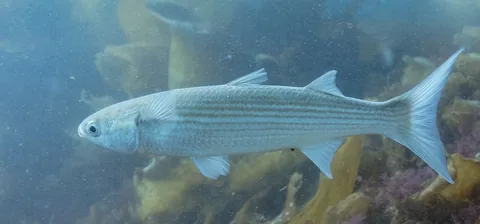
Striped mullet have a bluish-gray or green back, silvery sides, indistinct horizontal black stripes, and no black blotch at the base of the pectoral fin. The second dorsal starts over the anal fin. The white mullet profile says the same fish has bold stripes and 8 soft anal rays, and that white mullet have a gold or bronze spot on the opercle and the upper iris, nine or ten soft anal rays, and no distinct stripes. Fantail mullet on the Mugil trichodon profile have the pectoral blotch, an inverted V-shaped mouth, yellowish anal and pelvic fins, and a second dorsal that starts behind the anal fin. The bag does not split them apart.
Cast net size: 14 feet, and two nets on a boat
Cast net is legal gear for mullet, with hook and line, spears, gigs, and seine. Spearfishing mullet in fresh water is prohibited. The size of the net is not on the mullet page. It is on the net rule, and 14-foot cast net limit is the write-up. Rule 68B-39.006 repeats the 14-foot stretched length and the two-net cap for striped or silver mullet, and it caps a beach or haul seine at 500 square feet, no more than two unconnected nets from a vessel. The same rule lists snagging or snatch hooking as allowed gear. The recreational page does not list snagging.
In nearshore and inshore Florida waters the stretched length cannot exceed 14 feet. Stretched length is measured from the horn at the center, with the net gathered and pulled taut, to the lead line. It is not a radius, and it is not the length of the lead line around the skirt. No more than two cast nets may be fished from a single vessel at one time in those waters. A person who is not on a vessel may fish one net.
Nearshore and inshore, in Rule 68B-2.001, means inside 3 nautical miles on the Gulf and inside 1 nautical mile on the Atlantic. The cast-net page says the rule text read for that article does not state a cast-net length cap for state waters farther out. Read that page before you treat 14 feet as a cap on every Florida state water.
Pinellas and Charlotte County footnotes
FWC's mullet page does not state a Pinellas bag number. It says more restrictive seasonal bag limits apply to portions of Pinellas County, and seasonal night closures apply in portions of Charlotte County, and it points at Florida Rule 68B-39. The chapter file, opened October 31, 2026, does print the local lines.
68B-39.0045 is striped mullet only. From October 1 through January 31, in the areas the rule describes, no recreational or commercial harvester may take more than five striped mullet per day, and a vessel may not have more than five striped mullet aboard, no matter how many people are on it. The rule text names Riveria Bay and Bayou Grande, commonly known as Papy's Bayou; Placido Bayou, commonly known as Smack's Bayou; Snell Isle Harbour; Coffee Pot Bayou; the portion of Tampa Bay lying between those bayous; and the connecting waters west of the line the rule draws. It does not put silver mullet on that five-fish line.
68B-39.0046 is the Punta Gorda night closure, striped mullet only. From November 1 through the last day of February, no one may harvest or try to harvest striped mullet in the area the rule maps, from 6:00 p.m. until 6:00 a.m. Possession of striped mullet in or on those waters is prohibited during those hours. The boundary is the polygon in the rule, including a line 300 feet seaward of the shoreline and the western right-of-way of U.S. Highway 41. Read the coordinates in the rule before you treat a dock as inside or outside.
How to spot a school of mullet
The striped mullet profile calls them frequent leapers that feed on algae, decaying matter, and other tiny marine life. Juveniles move inshore at about 1 inch and travel far up tidal creeks. Adults migrate offshore in large schools to spawn. Seawalls, creek mouths, and the pier spans on this page are the inshore water those fish use. The bag and the vessel limit still apply when the school is thick.
How do you recognize a striped mullet?
- Striped mullet, Mugil cephalus, have a bluish-gray or green back, silvery sides, a white belly, and indistinct horizontal black stripes. Rule 68B-39.002 also calls this fish black mullet.
- The second dorsal fin starts over the beginning of the anal fin. The nose is blunt and the mouth is small. There is no black blotch at the base of the pectoral fin. The white mullet profile, describing the same fish, says the stripes are bold and counts 8 soft anal rays.
- White mullet, Mugil curema, on their profile: a stout silver body, a blackish blotch at the base of the pectoral fin, no distinct horizontal stripes, a gold or bronze spot on the opercle and the upper part of the iris, and nine or ten soft anal rays. Common up to 13 inches and less than 2 pounds.
- Fantail mullet on the profile titled Mugil trichodon: olive-green back with blue tints, yellowish anal and pelvic fins, a dark blotch at the base of the pectoral fin, an inverted V-shaped mouth, and no dark stripes. The second dorsal fin starts behind the beginning of the anal fin. Usually less than 1 pound. The recreational page still lists fantail mullet as Mugil gyrans.
- The striped mullet profile lists them common to 3 pounds and says the species is not currently eligible for a state record.
Where do the mullet bag limits apply?
Striped mullet use coastal water. Adults migrate offshore in large schools to spawn. Juveniles move inshore at about 1 inch and travel far up tidal creeks. FWC calls them frequent leapers that feed on algae, decaying matter and other tiny marine life. The white mullet profile puts that fish in fresh and brackish water as well as inshore water, often in large schools, spawning offshore in spring, and feeding on microscopic algae, detritus, and plankton. The fantail profile puts fantail mullet in coastal water, along beaches in the fall, spawning in nearshore or inshore water in spring and summer. The bag and the vessel limit apply in Gulf and Atlantic state waters. Fork length is the measurement FWC lists for mullet when a length is used. This recreational page sets no minimum size. This site is unofficial. Confirm the rule on the FWC mullet page before you fish.
Where to check pier access
- Skyway Fishing Pier State Park, St. Petersburg / Tampa Bay
- Fort De Soto Park Gulf & Bay Piers, Tierra Verde (Pinellas County)
- Venice Fishing Pier, Venice
- Naples Pier, Naples (Collier County)
- Jacksonville Beach Fishing Pier, Jacksonville Beach (Duval County)
- St. Johns County Ocean Pier, St. Augustine Beach (St. Johns County)
- Navarre Beach Pier, Navarre Beach (Santa Rosa County)
- Russell-Fields City Pier, Panama City Beach (Bay County)
Coasts and regions
- Panhandle & Emerald Coast fishing rules
- Tampa Bay fishing rules
- Sarasota & Southwest fishing rules
- Florida Keys fishing rules
- Jacksonville & Northeast fishing rules
- Southeast & Treasure Coast fishing rules
Related rule pages
- 14-foot cast net limit
- Tampa Bay rules
- Sarasota and Southwest rules
- Bag limits on a pier
- Flounder
- Sheepshead
- How fork length is measured
- 2026 closed seasons calendar
- Open now and closing soon
- What to catch by month
If the rule isn't clear
How many mullet can I keep in Florida?
50 fish per person per day in Gulf and Atlantic state waters. There is no minimum size, and the season is open year-round. FWC prints one rule for both coasts. The vessel limit on the recreational page is 50 fish from September 1 through January 31 and 100 fish from February 1 through August 31. Rule 68B-39.004 writes the 100-fish line for a vessel with two or more recreational harvesters. Portions of Pinellas County drop striped mullet to five fish from October 1 through January 31. Portions of Charlotte County close striped mullet at night from November 1 through the last day of February.
What is the mullet bag limit?
50 fish per person per day in Gulf and Atlantic state waters. There is no minimum size. Striped and silver mullet count together. In the rule, silver mullet includes white, fantail, and redeye.
What is the mullet vessel limit?
The recreational page prints 50 fish from September 1 through January 31, and 100 fish from February 1 through August 31. Rule 68B-39.004 says the 100-fish possession line is for a vessel with two or more recreational harvesters, in or on Florida waters. The page does not print that phrase.
Which mullet species are included?
The recreational page lists striped mullet (Mugil cephalus), silver or white mullet (Mugil curema), fantail mullet (Mugil gyrans) and redeye mullet (Mugil rubrioculus). Rule 68B-39.002 and the fantail profile call fantail mullet Mugil trichodon. The striped and white profiles still say M. gyrans. Striped mullet is also called black mullet in the rule.
Is mullet season open year-round?
The recreational page says open year-round. Two local rules cut that for striped mullet. In the Pinellas areas in Rule 68B-39.0045, the bag is five striped mullet per day, and no more than five aboard a vessel, from October 1 through January 31. In the Punta Gorda area in Rule 68B-39.0046, harvest and possession on the water are closed from 6:00 p.m. to 6:00 a.m., November 1 through the last day of February.
Can you spear mullet?
Spears and gigs are listed as legal gear on the recreational page. Rule 68B-39.006 allows spearing and also allows snagging or snatch hooking for striped or silver mullet. Spearfishing mullet in fresh water is prohibited on both the page and in the rule.
Is there a size limit on mullet in Florida?
Not for a recreational harvester. The recreational page prints None, and Rule 68B-39.003 says there is no recreational size limit for striped or silver mullet. The same rule sets a commercial minimum of 11 inches fork length for striped mullet, and it allows fish under that length up to 10 percent of the total whole weight of the striped mullet in possession. That commercial line is not the recreational minimum. The whole-condition sentence in that rule is written for a commercial harvester.
What is the Pinellas County mullet limit?
Rule 68B-39.0045: from October 1 through January 31, in the bayous and Tampa Bay water the rule describes, no more than five striped mullet per day, and no more than five striped mullet aboard a vessel. The rule spells one bay Riveria Bay and Bayou Grande, commonly known as Papy's Bayou, and it names Placido Bayou, commonly known as Smack's Bayou, Snell Isle Harbour, and Coffee Pot Bayou. It does not put silver mullet on that five-fish line. The recreational page does not print this number.
Pages we checked
- FWC: Saltwater Recreational Regulations
- FWC: Mullet
- FWC profile: Striped mullet
- FWC profile: White mullet
- FWC profile: Fantail mullet
- FWC: How to measure fish
- Florida Rule 68B-39
- Fla. Admin. Code 68B-39.002
- Fla. Admin. Code 68B-39.003
- Fla. Admin. Code 68B-39.004
- Fla. Admin. Code 68B-39.0045
- Fla. Admin. Code 68B-39.0046
- Fla. Admin. Code 68B-39.006