Tarpon catch-and-release rules in Florida
On this page
Varies by region
- SizeNo minimum. Over 40 inches must stay in the water unless a record is being pursued with a tarpon tag
Tarpon are catch-and-release: Gulf and Atlantic waters, no minimum size. A fish over 40 inches has to stay in the water unless you're after a state or world record and you have a tarpon tag. One tag per person per year. The vessel limit is one fish. Gear is hook and line only.
What you need in one box
- Harvest
- Catch-and-release only
- Size
- No minimum. Over 40 inches must stay in the water unless a record is being pursued with a tarpon tag
- Tag
- One tarpon tag per person per year
- Vessel
- Transport and shipment limited to one fish
- Gear
- Hook and line only

Tarpon limits
| Waters | Size | Bag | Season |
|---|---|---|---|
| Gulf and Atlantic, state and federal | None. Tarpon over 40 inches must remain in the water unless pursuing a state or world record with a tarpon tag | Catch-and-release only. One tarpon tag per person per year. Vessel, transport and shipment limited to one fish | Not listed as a closed season |
What marks a tarpon in the water?
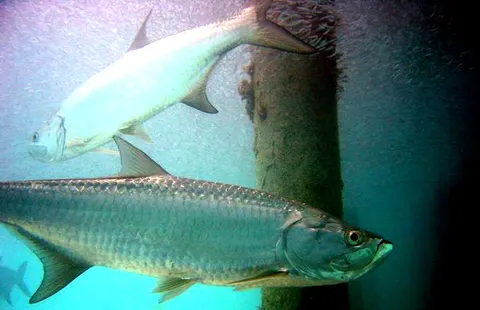
- FWC's tarpon profile: back dark blue-green or greenish-black, bright silver on the sides. One dorsal fin, with the last ray extended into a long filament. Very large scales. The mouth is large and points upward.
- The profile lists size up to 8 feet (300 pounds). The state record on that profile is 243 lb, caught near Key West.
- As juveniles, the profile says tarpon resemble ladyfish, E. saurus.
- The regulations page says a tarpon over 40 inches must stay in the water unless you have a tarpon tag and are pursuing a state or world record. It does not say total length or fork length. The photo FAQ says more than 40 inches fork length.
A fish people set it beside
- Common snook. Snook have a slot limit and a snook permit. Tarpon are catch-and-release, with a 40-inch handling rule.
- Ladyfish. FWC's tarpon profile says juvenile tarpon resemble ladyfish, E. saurus.
Where do the tarpon rules apply in Florida?
The rule covers state and federal waters in the Gulf and the Atlantic. Sharks often eat a tarpon during the fight, and FWC recommends you skip bridges and piers: only a tarpon under 40 inches may come out of the water, so a bigger one gets cut off with line still trailing. Boca Grande Pass has its own gear rules all year, and tighter line limits in April, May and June. If you aren't sure a jig is legal in the Pass, the regional office on the FWC page is 863-648-3200.
Unofficial. FL Fish Rules is not the Florida Fish and Wildlife Conservation Commission. Confirm the handling rule and the Boca Grande gear rule on MyFWC's tarpon page before you fish.
Marks on FWC's tarpon profile
The tarpon profile lists a dark blue-green or greenish-black back, bright silver sides, one dorsal fin with the last ray drawn into a long filament, very large scales, and a large mouth that points upward. Size on that profile: up to 8 feet (300 pounds). State record on the profile: 243 lb, caught near Key West. Juveniles resemble ladyfish, which the profile writes as E. saurus. Adults spawn offshore. In summer they are spread along the coast. In winter the profile says they concentrate in South Florida. They gulp air at the surface. A long, heavy monofilament leader is there to keep the gill plate or the tail from cutting the line.
The 40-inch line, in both wordings
Fetched October 31, 2026, the regulations page says tarpon over 40 inches must remain in the water unless you are pursuing a state or world record with a tarpon tag. It does not say total length or fork length. Keep the gills in as much water as is safely possible. The handling list on that page says the tag is purchased before fishing begins.
The same day's tarpon FAQ photo answer says a tarpon more than 40 inches fork length must remain in the water when it has no tag. Other answers on that FAQ say "more than 40 inches" and do not repeat "fork length." FWC's measurement page does not put tarpon on the total-length list or the fork-length list. This site does not pick a method. The size cell above is still the regulations-page sentence. How to measure shows both methods.
The FAQ allows temporary possession for a photo, for length and girth, and for scientific sampling, with that 40-inch stipulation. You may tow a tarpon only if it is tagged and you believe it may qualify for a state or world record. The profile's fishing tips say you must buy the tag in advance and, in that sentence, may do so only for a Florida state record. The regulations page and the FAQ say a state or world record.
Tags: the regulations page says one tarpon tag per person per year, and vessel, transport, and shipment limited to one fish. The FAQ says one per person per year except for charter boat captains, and it does not print the captain's number. A fish under 40 inches, if it comes out of the water, should be held with wet hands and supported horizontally under the belly. Keep fingers off the gills and the eyes.
Gear that is a rule, and gear that is advice
The rule is hook and line only. Snagging, snatch hooking, spearing, and a multiple hook used with live or dead natural bait are prohibited. The FAQ defines snagging as catching or attempting to catch tarpon that have not been attracted or enticed to strike your gear. That definition is statewide.
Circle hooks are recommended. The FAQ says they are not required. If you catch a reef fish on a non-circle hook while you are targeting tarpon, that reef fish must be released. The best-practices list, which is not the gear prohibition, says when you use bait use non-stainless, non-offset, barbless circle hooks, and use single-hook rigs. Have a long-handled dehooking tool. FWC's example for large tarpon on spinning or conventional tackle is a medium to extra-heavy rod, a 5,000 to 10,000 series reel, at least 12 pounds of drag, 50 to 60-pound braid, at least 60 to 80-pound mono or fluorocarbon leader, and 6/0–10/0 circle hooks. The fly example is a 10 to 12-weight with a break section of 15 to 25-pound test in the leader. The fly bullet is printed "Crimp barbs down on files."
If a shark shows up, FWC's advice is to get the fish to the boat and cut the line close to the hook, then move. The same section recommends you skip bridges and piers. Only a tarpon under 40 inches may come out of the water, so a bigger fish from a bridge or pier gets cut off with line still trailing.
Boca Grande Pass
Year-round, for any species, a weight attached to a hook, artificial fly, or lure so that the weight hangs lower than the hook when the line hangs straight down is prohibited inside the Pass. Live or dead natural bait is not a weight. Anything else attached so it hangs lower than the hook could be. A jig whose weight can slip down the shank to the bottom of the hook is prohibited. If that gear is on the boat inside the Pass, it cannot be on a rod, line, or leader, and it must be stowed. In April, May, and June, no more than three fishing lines may be deployed from a vessel, and breakaway gear is prohibited. The FAQ says those two limits still apply, for any species. If you are not sure about a jig, the page lists the regional office at 863-648-3200. The FAQ contact line is 850-487-0554.
FWC's boundary list for the Pass:
| Point | Latitude | Longitude |
|---|---|---|
| Charlotte Harbor Channel LB6 | 26° 42.299′ N | 82° 16.551′ W |
| Concrete Pier | 26° 43.165′ N | 82° 15.778′ W |
| Phosphate Dock | 26° 43.216′ N | 82° 15.517′ W |
| Intracoastal Waterway | 26° 43.216′ N | 82° 14.703′ W |
| Flashing Green #75 | 26° 42.299′ N | 82° 14.580′ W |
| QR Test Buoy | 26° 42.002′ N | 82° 15.448′ W |
Where to check pier access
- Skyway Fishing Pier State Park, St. Petersburg / Tampa Bay
Coasts and regions
- Panhandle & Emerald Coast fishing rules
- Tampa Bay fishing rules
- Sarasota & Southwest fishing rules
- Florida Keys fishing rules
- Jacksonville & Northeast fishing rules
- Southeast & Treasure Coast fishing rules
Rules already written up
- How to measure a fish
- Common snook, including tarpon snook
- 2026 closed seasons calendar
- Open now and closing soon
- What to catch by month
Straight answers
Can you keep a tarpon in Florida?
Tarpon is catch-and-release only. One tarpon tag per person per year may be purchased when pursuing a Florida state or world record. The vessel, transport and shipment limit is one fish. The FAQ says the one-tag limit has an exception for charter boat captains and does not print the captain's number.
Can you lift a tarpon out of the water?
The regulations page says tarpon over 40 inches must remain in the water unless you are pursuing a state or world record and using a tarpon tag purchased before fishing begins. It does not say total length or fork length. The photo FAQ says more than 40 inches fork length. FWC says to keep the gills in as much water as is safely possible.
What gear is legal for tarpon?
Hook and line only. Snagging, snatch hooking, spearing, and multiple hooks with live or dead natural bait are prohibited. Circle hooks are recommended. The FAQ says they are not required.
What are the Boca Grande Pass rules?
Year-round, a weight that hangs lower than the hook when the line hangs straight down is prohibited for any species, and that gear must be stowed if it is on the boat. Natural bait is not a weight. In April, May and June, no more than three lines may be deployed from a vessel, and breakaway gear is prohibited.
Is the 40-inch tarpon rule fork length?
The regulations page does not say. It says over 40 inches. The photo FAQ says more than 40 inches fork length. FWC's measurement page does not list tarpon under total length or fork length. Both MyFWC wordings were fetched October 31, 2026.