Lionfish harvest rules in Florida
On this page
Open year-round
- SizeNone
- BagUnlimited
- SeasonOpen year-round
Lionfish have no minimum size and an unlimited daily bag, and harvest is open year-round in Gulf and Atlantic state and federal waters. A recreational fishing license is not required when you target lionfish with a pole spear, a Hawaiian sling, a handheld net, or any spearing device designed and marketed exclusively for lionfish. Hook and line and any other method require a recreational fishing license unless you are exempt. The default unregulated-species bag does not apply to lionfish.
What you need in one box
- Size
- None
- Bag
- Unlimited
- Season
- Open year-round
- Waters
- Gulf and Atlantic state and federal waters
- License
- Not required for pole spear, Hawaiian sling, handheld net, or a lionfish-only spear
- Unofficial
- This site is not FWC. Confirm the MyFWC lionfish page before you fish.

Lionfish limits
| Waters | Size | Bag | Season |
|---|---|---|---|
| Gulf and Atlantic state and federal waters | None | Unlimited | Open year-round |
Which lionfish do these rules cover?
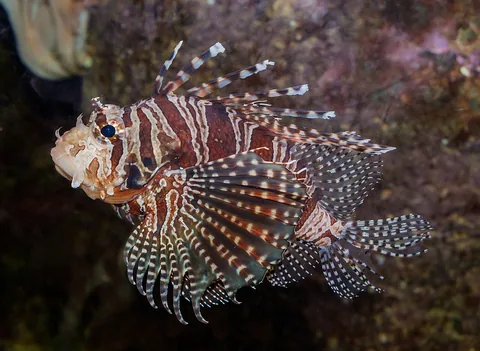
- The regulations page covers red lionfish, Pterois volitans, and devil firefish, Pterois miles.
- FWC calls lionfish an invasive species and encourages divers, anglers and commercial harvesters to remove them in Florida waters.
- Up to 18 venomous spines on the dorsal, pelvic and anal fins can cause painful stings. FWC lists swelling, blistering, dizziness, necrosis, and temporary paralysis. Immerse a sting in hot water, not scalding, for 30 to 90 minutes and seek medical attention if necessary.
- FWC says the venomous glandular tissue sits in the grooves of the spines, including at the base, and the venom can stay active after the fish is dead and stored on ice. Hold the fish by the bony gill plates or the soft pectoral fins. Puncture-resistant gloves are the precaution the page names.
Where can you remove lionfish in Florida?
Lionfish are native to the Indo-Pacific and the Red Sea. FWC says they are in Florida waters year-round, from North Carolina to South America, including the Gulf of America, in almost all estuarine and marine habitats, and in water up to 1,000 feet deep. They are rarely caught on hook and line. Spearing and a hand-held net are the removal methods FWC names. Keep the spear off the reef so it does not damage it. Spears may not be used within 100 yards of a public swimming beach, a commercial or public fishing pier, or any part of a bridge where public fishing is allowed, or within 100 feet of a jetty that is above the surface except for the last 500 yards of a jetty that extends more than 1,500 yards from shore. Spears are also prohibited in Monroe County from Long Key north to the Miami-Dade line, and in Florida state park waters, where possession of spearfishing equipment is prohibited unless it is unloaded and stored. Hand-held nets are still allowed in those places. Lionfish also turn up as bycatch when a commercial lobster or stone crab trap is pulled. FWC says there is evidence they are not stuck in the trap and can come and go, and they are harvested only when they happen to be inside as the trap comes up. Feeding lionfish to other predators while diving is dangerous and illegal, and FWC says it is not effective. FWC issues a special event non-native species removal permit only to tournaments, dive clubs, or other organized events that want to spear lionfish and other invasive species where spearing is not allowed. The email for that permit is on the MyFWC page. Sightings can go to the REEF form and the USGS Nonindigenous Aquatic Species form that FWC links. FWC says NOAA is particularly interested in Gulf of America sightings and in specimens.
Regions on this site
- Panhandle & Emerald Coast fishing rules
- Tampa Bay fishing rules
- Sarasota & Southwest fishing rules
- Florida Keys fishing rules
- Jacksonville & Northeast fishing rules
- Southeast & Treasure Coast fishing rules
Related rule pages
- Shore shark rules
- Spiny lobster
- Stone crab rules
- Spearing rules
- Unregulated species bag
- 2026 closed seasons calendar
- Open now and closing soon
- What to catch by month
If the rule isn't clear
Is there a lionfish bag limit?
No. The minimum size is none and the daily bag is unlimited. Harvest is open year-round in Gulf and Atlantic state and federal waters. FWC's unregulated-species page says the default bag does not apply to lionfish.
Do you need a fishing license to spear lionfish?
A recreational fishing license is not required for a pole spear, a Hawaiian sling, a handheld net, or any spearing device specifically designed and marketed exclusively for lionfish. Hook and line and other methods require a recreational fishing license unless you are exempt.
Where are lionfish spears prohibited?
Within 100 yards of a public swimming beach, a commercial or public fishing pier, or a bridge where public fishing is allowed. Within 100 feet of an exposed jetty, except the last 500 yards of a jetty longer than 1,500 yards. In Monroe County from Long Key north to the Miami-Dade County line. In Florida state park waters. Hand-held nets are allowed in these situations.
Can you import or breed lionfish?
Import of live lionfish, breeding, and harvest or possession of eggs and larvae for any purpose other than destruction is prohibited for all 10 species of the genus Pterois. Fish caught in state or federal waters off Florida may be landed and sold live in the aquarium trade. Live fish imported before Aug. 1, 2014 need documentation and the appropriate wholesale or retail license. The nonnative hotline on the page, 888-IVE-GOT-1, is for a pet you can no longer keep.
What if you are stung?
FWC says lionfish have up to 18 venomous spines on the dorsal, pelvic, and anal fins. A sting can cause swelling, blistering, dizziness, necrosis, and temporary paralysis. Immerse the wound in hot, not scalding, water for 30 to 90 minutes and seek medical attention if necessary.
Can a club spear lionfish where spearing is closed?
FWC says it only issues permits to tournaments, dive clubs, or other organized events that want to remove lionfish and other invasive species by spearfishing where spearing is not allowed. The email for that special event non-native species removal permit is on the MyFWC lionfish page.