Goliath grouper catch-and-release and harvest permit
On this page
Varies by region
- Slot24–36" total length
- Bag1 fish per person during the open season, with permit and tag
- SeasonOpen March 1 – May 31
Goliath grouper must be released immediately, alive and unharmed, unless you hold a recreational goliath harvest permit and tag and the fish meets the harvest rule. The slot is 24 to 36 inches total length. The bag is 1 fish per person during the open season. The season is March 1 through May 31. Closed areas are state waters of Martin County south through the Atlantic coast of the Keys, Dry Tortugas National Park, and all federal waters. Gear is hook and line only.
At a glance
- Harvest
- Prohibited without a recreational goliath harvest permit and tag
- Slot
- 24–36" total length
- Bag
- 1 fish per person during the open season, with permit and tag
- Season
- Open March 1 – May 31
- Gear
- Hook and line only

Goliath grouper limits
| Waters | Size | Bag | Season |
|---|---|---|---|
| Open areas with a recreational goliath harvest permit and tag | 24" – 36" total length | 1 fish per person during the open season, with permit and tag | Open March 1 – May 31 |
| Closed areas, and any water without that permit | Harvest prohibited | Release the fish immediately, alive and unharmed | Harvest is prohibited without a permit |
What does a goliath grouper look like?
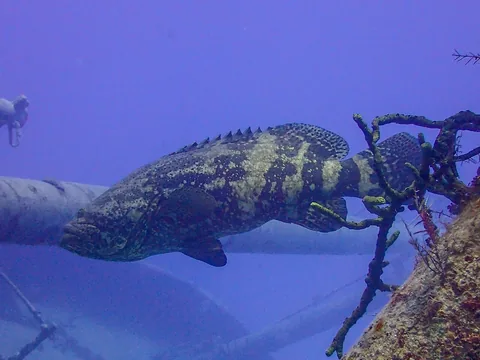
- Formerly called jewfish. Brown or yellow mottling, with small black spots on the head and fins. Young fish show five dark bars or stripes.
- A large mouth. The jawbones extend well past the small eyes, and the eyes are set forward. The tail and the pectoral fins are rounded. The profile adds tiny dark spots on the head and fins, irregular dark bars on the sides, a first dorsal fin much shorter than the second, and dorsal spines that are low and nearly the same height.
- Epinephelus itajara. FWC says this is the largest Atlantic grouper and can reach 800 pounds and over 8 feet.
- The Florida record on the page is a 680-pound fish caught off Fernandina Beach in 1961.
Other groupers
- Warsaw grouper. FWC's goliath profile lists warsaw grouper, H. nigritus, as the similar species. Warsaw dorsal spines sit at varying heights. Goliath dorsal spines are low and nearly the same height.
- Gag grouper. Gag have their own size and season. Goliath harvest uses the permit, tag, and 24 to 36 inch slot on this page.
- Black grouper. A different grouper with its own bag and season. Goliath stay in the water unless you are harvesting under the permit.
Where is goliath harvest closed in Florida?
The profile puts goliath in coastal and nearshore water around natural and man-made structure, or on muddy bottom. Young fish are often in estuaries, around mangroves, bridges, docks and artificial reefs, and can stay there 5 or 6 years. FWC names the Ten Thousand Islands as a juvenile center. Adults move to shallow reefs and like overhangs, ledges, bridges, piers and wrecks. The species is more abundant in southern Florida than in northern Florida. The regulations page says adults are generally solitary away from spawning. Spawning groups of 100 or more form in the eastern Gulf in July, August and September. The profile puts spawning from June through October, with the peak in July through September, and average lifespan at 30 to 50 years. That same regulations page says the maximum known age is at least 37 years, and it uses the name Gulf of America for the historical range. Calico crabs are most of the diet. Harvest stays prohibited in the closed areas and in every water where you do not hold the permit and tag. Bridges and piers on this site are structure, not a statement that harvest is open there.
Pier pages that match the habitat
- Skyway Fishing Pier State Park, St. Petersburg / Tampa Bay
- Long Key Viaduct Fishing Bridge, US-1, MM 63–65.5 (Monroe County)
- Ohio–Bahia Honda Channel Fishing Bridge, Lower Keys, US-1 (Monroe County)
- Sebastian Inlet State Park (jetties), Melbourne Beach (Brevard/Indian River counties)
- Fort Pierce Inlet State Park, Fort Pierce (St. Lucie County)
- Jupiter Inlet at DuBois Park, Jupiter (Palm Beach County)
Which region pages apply
- Panhandle & Emerald Coast fishing rules
- Tampa Bay fishing rules
- Sarasota & Southwest fishing rules
- Florida Keys fishing rules
- Jacksonville & Northeast fishing rules
- Southeast & Treasure Coast fishing rules
Unofficial. This site is not the Florida Fish and Wildlife Conservation Commission. Confirm the current rule on the MyFWC page for Goliath grouper before you fish.
Rules already written up
- Gag grouper
- Red grouper
- State Reef Fish Angler designation
- Scamp
- Yellowfin grouper
- Yellowmouth grouper
- Snowy grouper
- Red hind and rock hind
- Coney and graysby
- Yellowedge and misty grouper
- Warsaw grouper and speckled hind
- Reef fish gear
- How to measure fish
- Biscayne National Park
- 2026 grouper season calendar
- State and federal waters
- State Reef Fish Survey
- 2026 closed seasons calendar
- Open now and closing soon
- What to catch by month
Questions anglers ask
Can you keep a goliath grouper?
Only with a recreational goliath harvest permit and tag, and only when the fish is in the 24 to 36 inch total-length slot, during March 1 through May 31, in an open area. Otherwise release it immediately, alive and unharmed.
Where is goliath harvest closed?
State waters of Martin County, including the St. Lucie River and its tributaries, south through the Atlantic coast of the Keys, Dry Tortugas National Park, and all federal waters.
How many harvest permits are issued?
200 permits each year, by a random-draw lottery. Applications are October 1 through 15 each year at GoOutdoorsFlorida.com. The application fee is $10 and is non-refundable. An awarded permit is $150 for Florida residents and $500 for non-residents. Permits are non-transferable. Category I includes Everglades National Park. Category II does not.
What hooks are required?
Hook and line only. Non-offset, non-stainless steel circle hooks are required when using natural baits. A dehooking device is required when you release a goliath you are not harvesting.
What do you report after a harvest?
Tag the fish on the lower jawbone immediately. Report the harvest within 24 hours at GoOutdoorsFlorida.com or in the Fish|Hunt Florida app. If you do not harvest a fish, report that within 24 hours after the season closes. Provide a biological sample if the permit requires one.
How big is a mature goliath?
FWC says first maturity is about 36 inches, at 5 or 6 years. Males mature around 42 inches. Females first mature at 6 or 7 years and 47 to 53 inches. The harvest slot is 24 to 36 inches total length, and only with a permit and tag.
Can you feed a goliath grouper?
The goliath regulations page does not print a feeding rule. It links FWC's fish-feeding page under the question of feeding goliath, sharks, or other fish. Read that page before you chum or hand-feed.