Bonefish catch-and-release rules in Florida
On this page
Varies by region
Bonefish are catch-and-release only. The tournament exemption ended September 1, 2013. Rule 68B-34.006 says you may target them only with hook and line, and a multiple hook with live or dead natural bait is prohibited. Hold one fish only to photograph, measure, or weigh it on a hand-held scale where you caught it, then release it there. FWC says you can catch them year-round in the Keys, with a peak generally from March through October.
Short version
- Harvest
- Catch-and-release only. Rule 68B-34.003 says there is no size limit.
- Tournament weigh-in
- Exemption eliminated; change effective Sept. 1, 2013
- Gear
- Hook and line only in rule 68B-34.006. A multiple hook with live or dead natural bait is prohibited.
- In hand
- One fish, only to photograph, measure, or weigh on a hand-held scale at the spot you caught it, then release it there alive
- When in the Keys
- Year-round catch and release. The biology text says a peak generally March through October. That peak is not a harvest season.

Bonefish limits
| Waters | Size | Bag | Season |
|---|---|---|---|
| Florida | No harvest size. Catch-and-release only | No harvest bag. Possession for tournament scales is not allowed | Catch-and-release. Keys season in the biology text: year-round, peak generally March through October |
What does a bonefish look like on the flat?
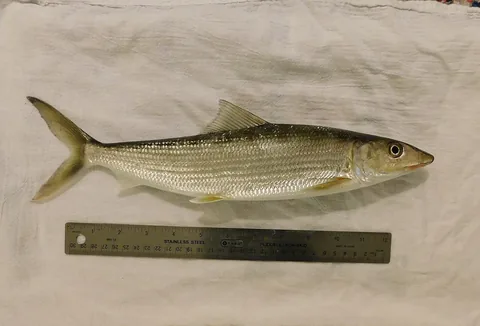
- Silvery, with a bluish or greenish back, a slender round body, and a long snout that overhangs the lower jaw. The profile says the tail is deeply forked.
- Dark streaks on the upper half of the body and faint cross-bands down to the lateral line. The extremities of the dorsal and tail fins are shaded black.
- The recreational page says the common bonefish, Albula vulpes, dominates Florida's recreational fishery. Many juveniles have been identified as bigeye bonefish, Albula garcia. The rule defines bonefish as the family Albulidae, or any part thereof.
- The profile lists size up to 18 pounds, rarely more than 10, with an average of 3 to 5 pounds, and says fish over 10 pounds are found in Florida. The state record is 16 lb 3 oz, caught near Islamorada. The rules page says they grow to three feet and 15 pounds.
Flats fish nearby
- Ladyfish. The bonefish profile lists ladyfish, E. saurus, as the similar species. The mouth sits at the very front of the head. A bonefish snout overhangs the lower jaw.
Where do bonefish tail in Florida?
Bonefish are inshore fish in shallow water, often less than one foot deep, usually over seagrass and now and then over white sand. The recreational page calls them the grey ghosts of the flats. The profile says they travel in small schools, with keen eyesight and a skittish nature, and eat shrimp, crabs and other invertebrates. The shallow flats of the Florida Keys and Biscayne Bay are the water that page names for large bonefish. You can catch them year-round in the Keys, with the peak generally March through October. Spawning is November through May. The profile says they are very seldom eaten and should be carefully released. Live shrimp, or a jig tipped with shrimp, is the bait the profile names for conventional tackle. Fly anglers pole the flats. Rule 68B-34.006 limits targeting them to hook and line.
Regions on this site
Related rule pages
- How to measure fish
- Biscayne National Park bonefish area
- Ladyfish, the profile's similar species
- 2026 closed seasons calendar
- Open now and closing soon
- What to catch by month
Questions and answers
Can you keep a bonefish in Florida?
No. Bonefish are catch-and-release only. The tournament exemption that allowed temporary possession for a tournament scale ended September 1, 2013. Rule 68B-34.004 lets a recreational angler hold one bonefish only to photograph, measure, or weigh it with a hand-held scale, at the site where it was caught, then release it alive and unharmed, immediately, in that same spot. You may not harvest or unnecessarily destroy one. Commercial harvest and possession are prohibited.
Can you use a treble hook with bait for bonefish?
No. The recreational page prohibits a multiple hook with live or dead natural bait, effective September 1, 2013. Rule 68B-34.006 says the same, and it also says you may target a bonefish only with hook and line. All other gear is prohibited.
When is bonefish season in the Keys?
Rule 68B-34.005 says there are no seasons, because bonefish is a year-round catch and release fishery. The recreational page says bonefish can be caught year-round in the Keys, and that the peak is generally March through October. That peak is biology, not a harvest season. A separate Biscayne National Park area, 1.74 square miles, prohibits fishing and possession of fish from March 1 through May 31, effective March 1, 2026, to protect a bonefish pre-spawning aggregation. That closure is not statewide and it is not limited to bonefish.
How big do bonefish get?
The rules page says they grow to three feet and 15 pounds and mature at 17 to 18 inches total length. The profile says up to 18 pounds, rarely more than 10, average 3 to 5 pounds. The state record is 16 lb 3 oz, near Islamorada. None of those figures is a size you can keep.
Which bonefish does the rule cover?
Rule 68B-34.002 defines bonefish as a fish of the family Albulidae, or any part thereof. The recreational page says Albula vulpes, the common bonefish, dominates the recreational fishery, and that many juveniles caught in Florida have been identified as bigeye bonefish, Albula garcia.